⚠️ Content Protected
Join our Telegram for PDF: t.me/BankPromotionExamGuide
DEA Fund Scheme MCQs – 12 Most Expected Questions ⏳ Updated: Apr 2026 | 🎯 12 MCQs
⚠️ Select an answer!
Under which section of the Banking Regulation (BR) Act, 1949, was the Reserve Bank of India (RBI) empowered to formulate "The Depositor Education and Awareness Fund (DEA Fund) Scheme, 2014"?
Explanation:
Correct: A
The Reserve Bank of India (RBI) formulated "The Depositor Education and Awareness Fund (DEA Fund) Scheme, 2014" using the powers conferred upon it under Section 26A of the Banking Regulation (BR) Act, 1949.
▶ Watch Video Explanation
Which of the following types of amounts are credited to the DEA Fund, if they remain unclaimed for 10 years or more?
1. Credit balances from loan accounts, after due appropriation by the banks.
2. Outstanding demand drafts and pay orders.
3. Balances in sundry deposit accounts and vostro accounts.
4. Amounts outstanding against travellers cheques, which have no maturity period.
1. Credit balances from loan accounts, after due appropriation by the banks.
2. Outstanding demand drafts and pay orders.
3. Balances in sundry deposit accounts and vostro accounts.
4. Amounts outstanding against travellers cheques, which have no maturity period.
Explanation:
Correct: B
The amounts credited to the DEA Fund include credit balances from loan accounts (after due appropriation), outstanding demand drafts, pay orders, sundry deposit accounts, and vostro accounts. However, amounts outstanding against travellers cheques or similar instruments without a maturity period are explicitly excluded.
▶ Watch Video Explanation
What is the minimum period an amount must remain unclaimed or a deposit account must be inoperative, for the funds to be transferred to the Depositor Education and Awareness (DEA) Fund?
Explanation:
Correct: C
Amounts credited to the DEA Fund are from credit balances in deposit accounts that have not been operated upon for 10 years or more, or any amount remaining unclaimed for 10 years or more.
▶ Watch Video Explanation
When did the Depositor Education and Awareness (DEA) Fund Scheme, 2014, come into effect?
Explanation:
Correct: A
The Scheme came into effect from May 24, 2014, which was the date of its notification in the Official Gazette of India.
▶ Watch Video Explanation
After remaining unclaimed for 10 years or more, all of the following amounts are credited to the DEA Fund EXCEPT:
Explanation:
Correct: A
The amounts credited to the Fund include undrawn balances from prepaid cards, rupee proceeds of foreign currency deposits, and margin money. However, amounts outstanding against travellers cheques or similar instruments without a maturity period are explicitly excluded.
▶ Watch Video Explanation
Advertisement
When are banks required to transfer the credit balances from 10-year inoperative or unclaimed accounts to the DEA Fund?
Explanation:
Correct: C
Banks are required to transfer the funds on the last working day of the month subsequent to the month of completing 10 years of inoperative or unclaimed status. For example, deposits becoming due in April are transferred on the last working day of May.
▶ Watch Video Explanation
When a bank transfers the amount from a 10-year unclaimed deposit to the DEA Fund, what happens to the interest accrued on that deposit?
Explanation:
Correct: C
Banks are required to transfer the entire amount to the DEA Fund, which includes the accrued interest as on the date of the transfer.
▶ Watch Video Explanation
Consider the following statements:
Assertion (A) - A depositor can reclaim their unclaimed amount from their bank even after the bank has transferred the funds to the DEA Fund.
Reason (R) - The bank, upon receiving a claim, repays the depositor and then lodges a claim for an equivalent amount from the DEA Fund maintained by the RBI.
Assertion (A) - A depositor can reclaim their unclaimed amount from their bank even after the bank has transferred the funds to the DEA Fund.
Reason (R) - The bank, upon receiving a claim, repays the depositor and then lodges a claim for an equivalent amount from the DEA Fund maintained by the RBI.
Explanation:
Correct: A
A depositor can claim a refund of their unclaimed amounts from their bank. The bank shall repay the customer (with interest, if applicable) and then lodge a claim for a refund from the DEA Fund for the equivalent amount paid.
▶ Watch Video Explanation
There is ...... prescribed in the Scheme for a customer/depositor for claiming a refund from the DEA Fund.
In the event that a bank is under liquidation, who should a depositor approach to claim their unclaimed deposit amount that was previously transferred to the DEA Fund?
Advertisement
For a bank under liquidation, if a customer's deposit was covered by DICGC at the time of transfer to the DEA Fund, how does the Liquidator handle the claim (up to the insured amount)?
For a bank under liquidation, if a DICGC-insured deposit claim (e.g., 6 lakh) is more than the DICGC insurance cover (e.g., 5 lakh), how is the amount in excess of the cover (e.g., 1 lakh) handled?
Looking for the most important DEA Fund Scheme MCQs for your upcoming exams? We have analyzed past papers for Bank Promotion Exams to bring you the 12 most expected questions. Take the live test, review the blueprint, and master the core concepts.
- 🚀 Updated for 2026: Aligned with the latest Bank Promotion Exams syllabus.
- 🧠 Output & Concept Based: Covers basics to advanced scenarios.
- 📊 Live Gamification: Track your score and time dynamically.
- 📥 Free PDF Notes: Available instantly via our Telegram channel.
Test Blueprint & Topic Weightage
| DEA Fund – Establishment & Legal Basis | Q1 – Q4 | Easy to Medium |
| Scope and Fund Transfer Rules | Q5 – Q7 | Medium |
| Claims Process and Liquidation Rules | Q8 – Q12 | Hard |
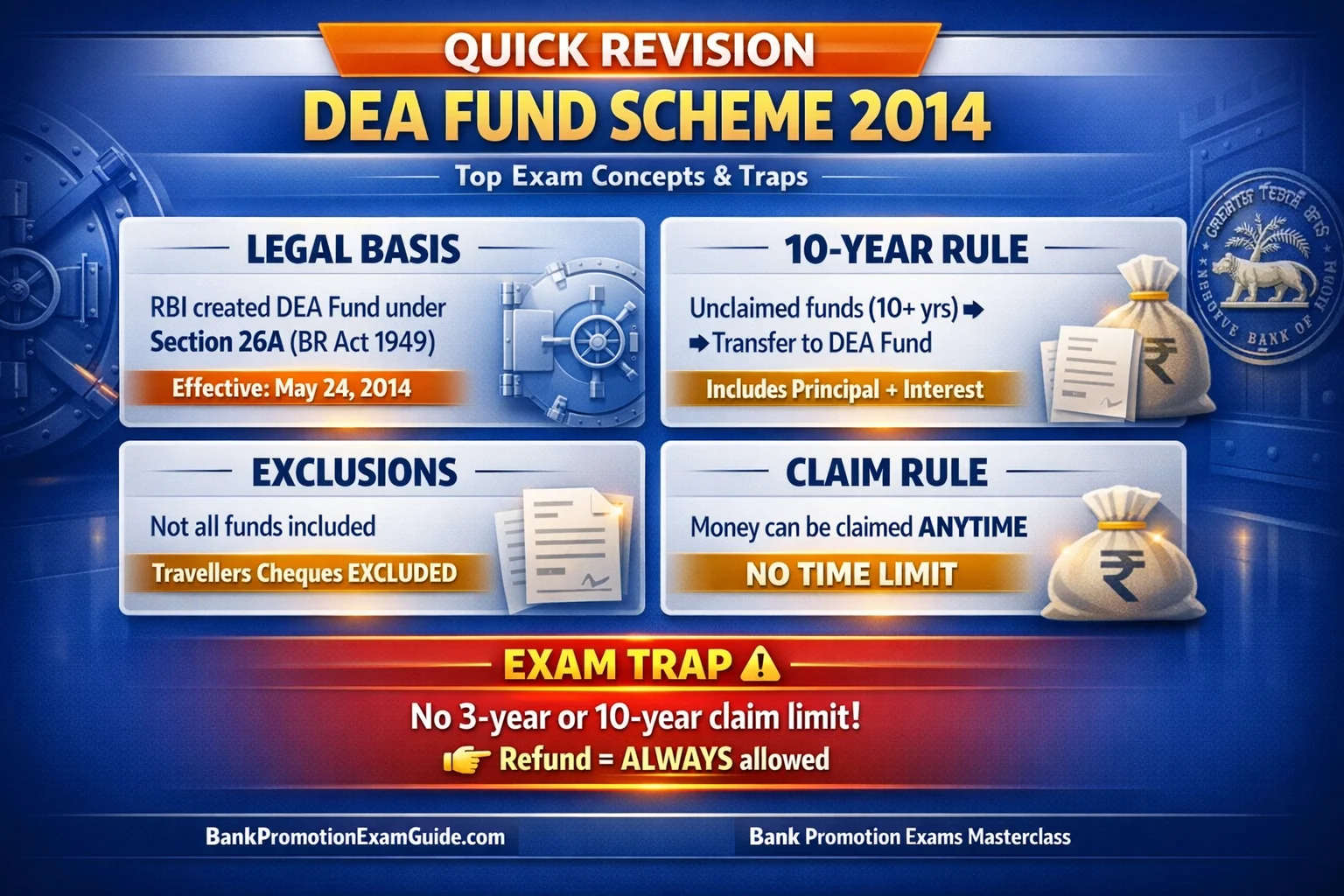
⚠️ Examiner Trap Alert: A common examiner trick is confusing students on the claim time limit. Students often mistakenly assume there is a strict 3-year or 10-year limit to claim a refund from the DEA Fund, but legally, there is absolutely NO specific time limit for a depositor to claim their money back.
Practice DEA Fund Scheme MCQs (Live Mock Test)
⏱️ Estimated Time: 18 Minutes | 🎯 Target Score: 10+ | 📊 Difficulty: Moderate to Hard
High-Yield Core Concepts
Legal Foundation: The scheme is legally empowered by Section 26A BR Act, 1949, giving RBI the authority to manage long-term dormant funds.
The 10-Year Rule: Credit balances, including DDs and Vostro accounts, become Unclaimed Deposits and must be transferred to the DEA Fund after 10 years of inoperation.
Transfer Value: Banks are required to transfer the entire amount—meaning the principal plus all accrued interest up to the date of transfer.
Bank Liquidation Handling: A Liquidator DICGC Claim is made by the liquidator on behalf of the customer up to the insurance cover limit; anything exceeding the cover is strictly claimed on a reimbursement basis.
Semantic Comparison: DEA Fund vs DICGC
| Core Definition | A repository for deposits unclaimed for 10+ years | An insurance cover protecting deposits in case of bank failure |
| Primary Use Case | Promoting depositor awareness and holding dormant funds | Reimbursing depositors up to ₹5 Lakhs during bank liquidation |
| Exam Importance | Crucial for operational banking compliance | Crucial for risk management and bank closure procedures |
Frequently Asked Questions
Why are DEA Fund Scheme MCQs critical for Bank Promotion Exams?
It is a consistently high-scoring area. Examiners frequently repeat core concepts regarding the 10-year rule and Section 26A BR Act compliance.
Does this mock test cover the full syllabus?
Yes, these questions target the most highly-weighted concepts found in previous years’ papers regarding Unclaimed Deposits and claim procedures.
What are the most repeated topics?
Based on our blueprint, the Claims Process during liquidation and the exact mechanisms of a Liquidator DICGC Claim carry the highest weightage.