⚠️ Content Protected
Join our Telegram for PDF: t.me/BankPromotionExamGuide
Indian Contract Act MCQs – 19 Most Expected Questions ⏳ Updated: Apr 2026 | 🎯 19 MCQs
⚠️ Select an answer!
Which of the following statements, regarding a minor's capacity to contract, are correct?
1. A minor is legally considered incompetent to enter into a contract of debt.
2. A loan contract with a minor is void, prohibiting banks from granting such loans.
3. A minor is permitted to open a deposit account, which is typically operated by a guardian.
4. A minor is legally permitted to act as a guarantor for a loan.
1. A minor is legally considered incompetent to enter into a contract of debt.
2. A loan contract with a minor is void, prohibiting banks from granting such loans.
3. A minor is permitted to open a deposit account, which is typically operated by a guardian.
4. A minor is legally permitted to act as a guarantor for a loan.
Explanation:
Correct: B
A minor is legally incompetent to enter a contract of debt (void ab initio). Therefore, a minor cannot borrow, pledge assets, or act as a guarantor (making Statement 4 incorrect). A minor can, however, open a deposit account operated by a guardian.
▶ Watch Video Explanation
If a bank obtains a customer's signature on a loan document, by using coercion, misrepresentation, or undue influence,
what is the legal status of that contract?
what is the legal status of that contract?
Explanation:
Correct: A
For a contract to be valid, consent must be free. If consent is obtained via coercion, misrepresentation, or undue influence (as per the Indian Contract Act), the contract becomes voidable at the option of the aggrieved party.
▶ Watch Video Explanation
"A contract of guarantee is considered invalid, unless the bank provides separate, direct consideration to the surety."
Explanation:
Correct: C
This statement is false. Section 127 of the Indian Contract Act states that anything done for the benefit of the principal debtor (e.g., the bank giving the loan) is sufficient consideration for the surety's guarantee. No separate, direct consideration to the surety is required.
▶ Watch Video Explanation
What is the consequence for a bank, if it provides a loan for a purpose that it knows to be unlawful?
Explanation:
Correct: B
One of the essentials of a valid contract is a lawful object (Section 23, Indian Contract Act). If the purpose of the loan is unlawful, the contract is void and cannot be enforced by the bank to recover the money.
▶ Watch Video Explanation
A bank guarantee, which is payable only on the happening of an uncertain event, such as a customer's default, is a classic banking example of a …… contract.
Explanation:
Correct: A
A contingent contract (Section 31, Indian Contract Act) is a contract to do or not to do something if some event, collateral to such contract, does or does not happen. A bank guarantee, payable only on a default, fits this definition.
▶ Watch Video Explanation
Advertisement
Which of the following procedures are mandatory, when a bank deals with an illiterate customer?
1. The customer's thumb impression must be witnessed.
2. The bank must read the terms of the contract aloud to the customer.
3. The customer must sign (or provide a thumb impression) in the presence of a bank officer.
4. A guardian must co-sign all documents.
1. The customer's thumb impression must be witnessed.
2. The bank must read the terms of the contract aloud to the customer.
3. The customer must sign (or provide a thumb impression) in the presence of a bank officer.
4. A guardian must co-sign all documents.
Explanation:
Correct: B
To ensure free and informed consent (avoiding undue influence), banks must read the contract terms aloud to an illiterate customer. The customer's thumb impression must be affixed in the presence of a bank officer and be properly witnessed. A guardian is not required unless the customer is also a minor.
▶ Watch Video Explanation
A customer signing a written loan agreement, is an example of an express contract. What is a common example of an implied contract in banking?
Explanation:
Correct: A
An express contract is stated in words (written or spoken), like a loan agreement. An implied contract is formed by the conduct of the parties. When a bank accepts a cheque for collection, an implied agency contract is created by the customer's action of depositing it.
▶ Watch Video Explanation
Which of the following statements, regarding bailment in banking, are correct?
1. When a bank accepts articles for "safe custody," a contract of bailment is created where the bank is the bailee.
2. The bank's primary duty in a "safe custody" bailment is to take reasonable care of the goods, and return them on demand.
3. A "safe deposit locker" is considered a modified bailment, because the bank does not take custody of the specific contents.
4. In a "safe deposit locker" relationship, the bank's only duty is to provide space, and it is not liable for exercising due care.
1. When a bank accepts articles for "safe custody," a contract of bailment is created where the bank is the bailee.
2. The bank's primary duty in a "safe custody" bailment is to take reasonable care of the goods, and return them on demand.
3. A "safe deposit locker" is considered a modified bailment, because the bank does not take custody of the specific contents.
4. In a "safe deposit locker" relationship, the bank's only duty is to provide space, and it is not liable for exercising due care.
Explanation:
Correct: B
"Safe custody" creates a standard bailment contract where the bank (bailee) must take reasonable care of the specific goods (Statements 1 & 2). A "safe deposit locker" is a modified bailment; the bank does not take custody of the unknown contents but must still exercise due care and diligence in protecting the locker (Statement 3 is correct, Statement 4 is incorrect).
▶ Watch Video Explanation
In the formation of a loan contract, what does the bank's sanction letter legally represent?
Banks often use a contract of indemnity, to protect themselves from loss.
Which of the following is NOT a typical situation, where a bank would take an indemnity?
Which of the following is NOT a typical situation, where a bank would take an indemnity?
Advertisement
In a standard bank loan guarantee, who are the three parties involved?
In a contract of guarantee, the surety's liability is …… with that of the principal debtor, meaning the bank can recover the debt from the guarantor without first exhausting all remedies against the borrower.
Consider the following statements:
Assertion (A): If a bank grants more time to the principal debtor to repay a loan, without the surety's permission, the surety is discharged from the guarantee.
Reason (R): Any variation made by the bank in the terms of the original loan contract, without the surety's consent, will discharge the surety.
Assertion (A): If a bank grants more time to the principal debtor to repay a loan, without the surety's permission, the surety is discharged from the guarantee.
Reason (R): Any variation made by the bank in the terms of the original loan contract, without the surety's consent, will discharge the surety.
For a continuing guarantee, such as one covering a Cash Credit (CC) or Overdraft (OD) limit, which event will revoke the guarantee for all future transactions?
Which of the following statements, regarding a contract of pledge, are correct?
1. A pledge is a contract where a customer delivers goods, such as gold or warehouse receipts, to a bank as security for a loan.
2. The bank, as the pawnee, has the right to sell the pledged goods if the borrower (pawnor) defaults on the loan.
3. Before the bank can sell the pledged goods upon default, it is legally required to give reasonable notice of the sale to the borrower.
4. The bank must obtain a court order before selling any pledged goods, even after a default.
1. A pledge is a contract where a customer delivers goods, such as gold or warehouse receipts, to a bank as security for a loan.
2. The bank, as the pawnee, has the right to sell the pledged goods if the borrower (pawnor) defaults on the loan.
3. Before the bank can sell the pledged goods upon default, it is legally required to give reasonable notice of the sale to the borrower.
4. The bank must obtain a court order before selling any pledged goods, even after a default.
Advertisement
Which of the following statements, regarding the banker's general lien, are correct?
1. Under Section 171 of the Indian Contract Act, a bank has a general lien, which is the right to retain a customer's securities for any general balance due.
2. The bank's general lien does not apply to items deposited by the customer for a specific purpose, such as safe custody.
3. A lien is primarily a right to retain possession, and does not automatically grant the bank the right to sell the securities.
4. A bank's general lien extends to the contents of a customer's safe deposit locker.
1. Under Section 171 of the Indian Contract Act, a bank has a general lien, which is the right to retain a customer's securities for any general balance due.
2. The bank's general lien does not apply to items deposited by the customer for a specific purpose, such as safe custody.
3. A lien is primarily a right to retain possession, and does not automatically grant the bank the right to sell the securities.
4. A bank's general lien extends to the contents of a customer's safe deposit locker.
In
which of the following situations, is the bank acting as an agent for the customer?
1. Collecting cheques for the customer's account.
2. Making payments based on standing instructions.
3. Distributing mutual fund products.
4. Granting a housing loan to the customer.
which of the following situations, is the bank acting as an agent for the customer?
1. Collecting cheques for the customer's account.
2. Making payments based on standing instructions.
3. Distributing mutual fund products.
4. Granting a housing loan to the customer.
When a bank and a borrower agree to an One-Time Settlement (OTS), or a restructuring of a loan, what type of discharge of contract does this represent?
If a bank wrongfully dishonours a customer's cheque, or fails to protect valuables left in its safe custody, what remedy does the customer have under contract law?
Looking for the most important Indian Contract Act MCQs for your upcoming exams? We have analyzed past papers for Bank Promotion Exams to bring you the 19 most expected questions. Take the live test, review the blueprint, and master the core concepts.
- 🚀 Updated for 2026: Aligned with the latest Bank Promotion Exams syllabus.
- 🧠 Output & Concept Based: Covers basics to advanced scenarios.
- 📊 Live Gamification: Track your score and time dynamically.
- 📥 Free PDF Notes: Available instantly via our Telegram channel.
Test Blueprint & Topic Weightage
| Fundamentals of Contracts | Q1 – Q7 | Easy to Medium |
| Guarantee, Indemnity, and Bailment | Q8 – Q14 | Medium |
| Pledge, Lien, Agency, and Discharge | Q15 – Q19 | Hard |
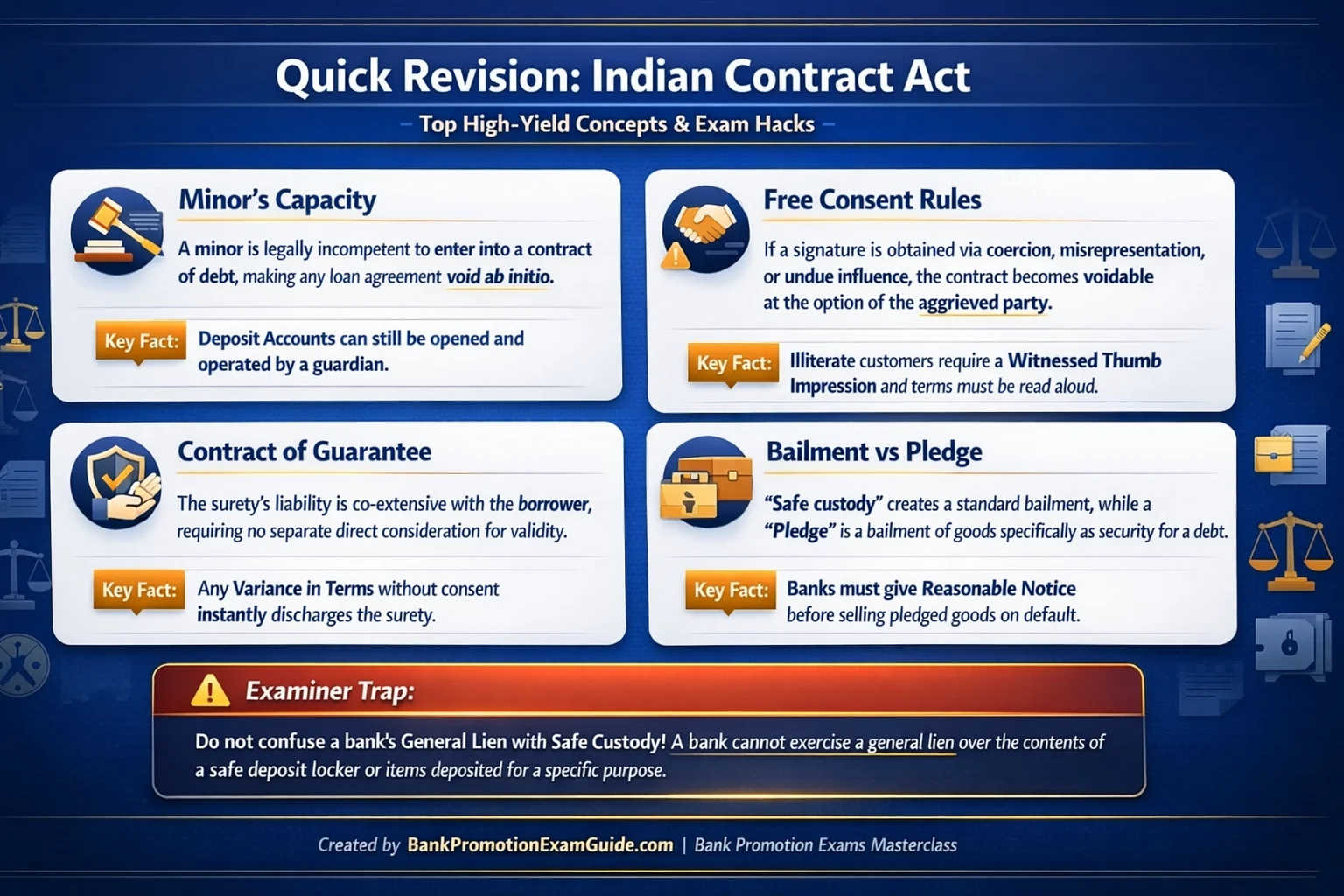
⚠️ Examiner Trap Alert: A common examiner trick is blurring the lines between a banker’s general lien and safe custody. Students often mistakenly assume a general lien applies to locker contents, but it legally only applies to securities held for a general balance, explicitly excluding items deposited for a specific safe custody purpose.
Practice Indian Contract Act MCQs (Live Mock Test)
⏱️ Estimated Time: 28.5 Minutes | 🎯 Target Score: 15+ | 📊 Difficulty: Moderate to Hard
High-Yield Core Concepts
Minor Capacity (Indian Contract Act): A minor’s loan contract is void ab initio, but they can legally open deposit accounts operated by a guardian.
Free Consent: If a signature is obtained via coercion or misrepresentation, it creates Voidable Contracts at the option of the aggrieved party.
Section 128 Contract of Guarantee: The surety’s liability is co-extensive with the principal debtor’s, allowing banks to seek direct recovery without suing the borrower first.
Banker’s General Lien: Banks can retain securities for general balances, a crucial aspect of the Banker and Customer Relationship, but this excludes safe deposit locker contents.
Semantic Comparison: Indian Contract Act MCQs vs Banking Regulation Act MCQs
| Core Definition | Rules governing general agreements, guarantees, and pledges | Rules governing the structural operation and licensing of banks |
| Primary Use Case | Loan agreements, safe custody, indemnity bonds | Statutory liquidity, capital reserves, RBI compliance |
| Exam Importance | Essential for understanding daily operational legalities | Essential for understanding macro-banking regulations |
Frequently Asked Questions
Why are Indian Contract Act MCQs critical for Bank Promotion Exams?
It is a consistently high-scoring area. Examiners frequently repeat core concepts from this section, as they form the legal backbone of all banking operations.
Does this mock test cover the full syllabus?
Yes, these questions target the most highly-weighted concepts found in previous years’ papers regarding contract law.
What are the most repeated topics?
Based on our blueprint, Fundamentals of Contracts and the rules surrounding Guarantee, Indemnity, and Bailment carry the highest weightage.