Looking for the most important NRI Banking for your upcoming exams? We have analyzed past papers for Bank Promotion Exams to bring you the 17 most expected questions. Take the live test, review the blueprint, and master the core concepts.
- 🚀 Updated for 2026: Aligned with the latest Bank Promotion Exams syllabus.
- 🧠 Output & Concept Based: Covers basics to advanced scenarios.
- 📊 Live Gamification: Track your score and time dynamically.
- 📥 Free PDF Notes: Available instantly via our Telegram channel.
Test Blueprint & Topic Weightage
| Section / Topic | Question Range | Difficulty Level |
|---|---|---|
| NRI Banking Basics & NRE Accounts | Q1 – Q6 | Easy to Medium |
| NRO Accounts, Tax Rules & Limits | Q7 – Q10 | Medium |
| FCNR(B) & Loan Regulations | Q11 – Q17 | Hard |
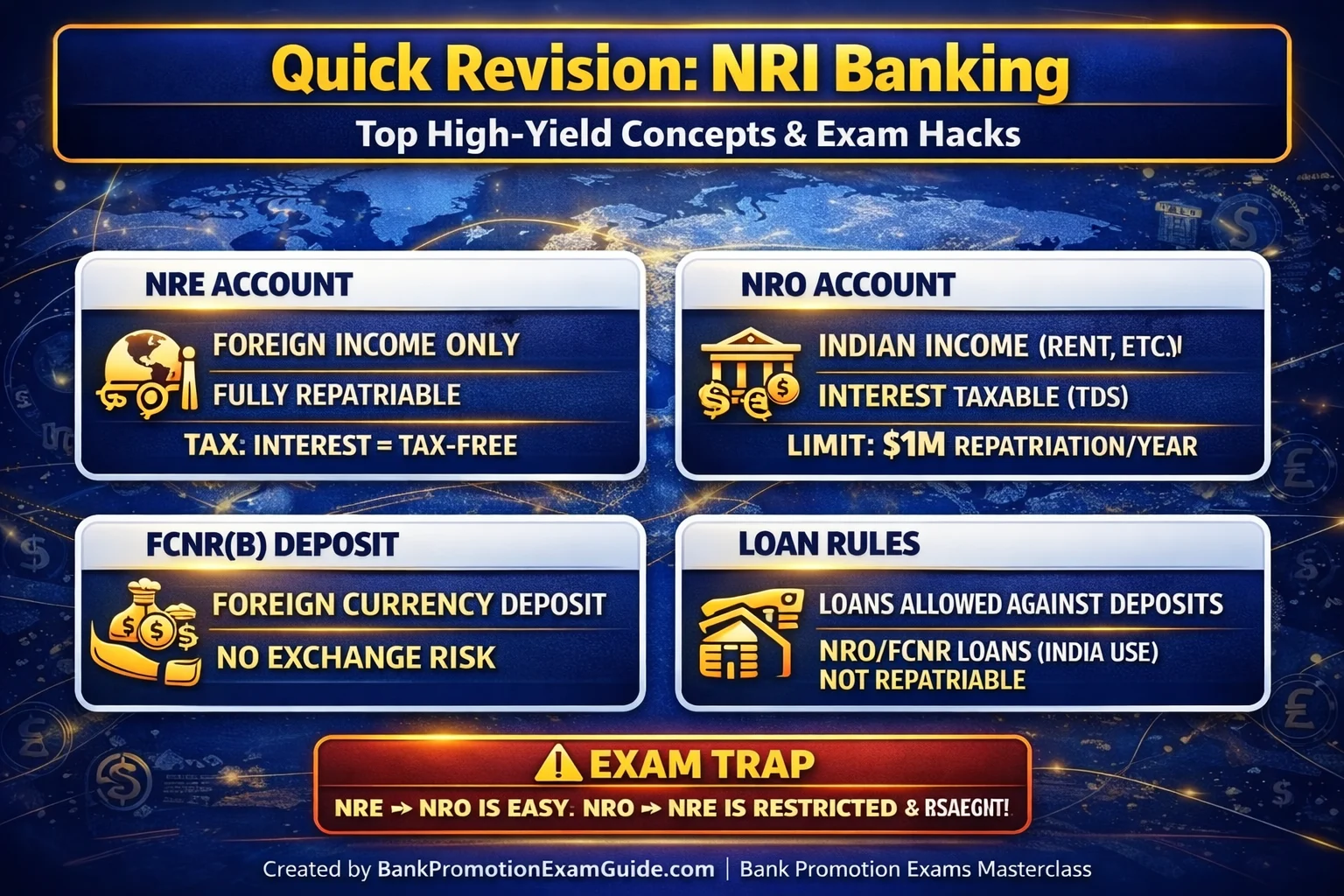
⚠️ Examiner Trap Alert: Students frequently assume that because transferring funds from NRE to NRO is easy, the reverse is also true. Examiners trick you here: funds moving from NRO back to NRE face heavy restrictions and require strict tax proofs, as NRO funds are generally non-repatriable!
Test Blueprint & Topic Weightage
⏱️ Estimated Time: 25 Minutes | 🎯 Target Score: 14+ | 📊 Difficulty: Moderate to Hard
📚 Interactive Question Bank
Select a question to view the expert explanation and answer.
✅ | NRI Banking Basics & NRE Accounts
Q1Siddharth moves to the UK for employment, and opens a Non-Resident External (NRE) account in India, to manage his finances. He seeks clarification on the account's features. Which of the following statements, regarding his NRE account, are correct?Q2Arjun, an NRI based in Dubai, wishes to involve his family in India, in managing his NRE account. He wants to add his resident father as a joint holder, and give a Power of Attorney (POA) to his brother. Which of the following arrangements are permitted, by RBI regulations?Q3Mr. Sharma, an NRI, visits his bank in Delhi, with four different cheques he wishes to deposit into his NRE account. Which of the following cheques will the bank REJECT, based on NRE permissible credit rules?Q4Rahul, an NRI, arrives in India for a vacation, carrying USD 6,000 in cash. He wishes to deposit this cash into his NRE account. Which of the following statements correctly describe, the banking procedure?Q5Vikram holds an NRE Fixed Deposit (FD), for a 3-year term. Due to a medical emergency, he requests the bank to close the FD, after only 8 months. What will be the impact, on the interest payable?Q6Anita, who has held an NRE account for years, returns to India, and takes up permanent employment, staying for more than 182 days. She informs her bank, of her change in residency status. What happens to her existing NRE deposits?
✅ | NRO Accounts, Tax Rules & Limits
Q7Karan, an NRI based in the UK, has several sources of funds, he wishes to manage in India. He decides to open an NRO (Non-Resident Ordinary) account. Which of the following transactions are permissible credits to this NRO account, under RBI regulations?Q8Dev, an NRI, sells a residential property in Bangalore for ₹80 lakhs. He wishes to repatriate the sale proceeds to the USA. He consults his tax advisor, regarding the procedure. Which of the following statements are correct?Q9Priya, an NRI living in Singapore, holds both an NRE Fixed Deposit, and an NRO Fixed Deposit in India. She notices a difference, in the tax treatment of the interest earned. Which of the following statements, accurately reflect the tax rules?Q10Rohit requires emergency funds while in India, and approaches his bank for a loan, against his NRO Fixed Deposit. The bank agrees to sanction the loan. Which of the following conditions, apply to this loan?
✅ | FCNR(B) & Loan Regulations
Q11Vimal, an NRI working in Germany, earns his salary in Euros. He is concerned about the fluctuation of the Indian Rupee, and wants to invest his savings in India, without exposing his principal to exchange rate risk. He decides to open a Foreign Currency Non-Resident (Bank) [FCNR(B)] account. Which of the following statements, regarding this account, are correct?Q12Leena opens an FCNR(B) Fixed Deposit, for a tenure of 3 years. After 2 years, she returns to India permanently, and becomes a resident. She asks her banker, about the status of her deposit. Which of the following statements, correctly describe the rules applicable to her situation?Q13Arjun requires funds for a business venture in India, and decides to avail a loan against his FCNR(B) deposit. He consults the bank, regarding the loan terms. Which of the following conditions, apply to such loans?Q14Priya, an NRI, wishes to open joint accounts with her mother, who is a resident of India. She explores two options: an NRE account, and an NRO account. She specifically wants to know, about the operating mandates allowed for these joint accounts. Which of the following statements, correctly describe the regulations?Q15Rita holds a USD 50,000 FCNR(B) Fixed Deposit, with a tenure of 3 years. One year into the term, she faces a liquidity crunch in India. She approaches the bank, to discuss her options. Which of the following statements, correctly outline the rules for managing this deposit?Q16Sagar holds a diverse portfolio including NRE Fixed Deposits, NRO Fixed Deposits, and an FCNR(B) deposit. He requires a loan of ₹50 lakhs to purchase a flat in Mumbai, and approaches his bank to avail a loan against these deposits. Which of the following statements, correctly describe the loan regulations across these account types?Q17Ajay decides to transfer ₹10 lakhs from his NRE savings account to his NRO savings account, to pay for local renovation expenses. Later, he wishes to move the remaining unspent amount back to his NRE account. He consults his banker, regarding the implications of the initial transfer. Which of the following statements are correct?
Page 1 of 1 (17 Total Questions)
High-Yield Core Concepts
NRE Account Repatriation
Governed by FEMA Guidelines, NRE accounts are strictly for foreign earnings, allowing full repatriation and completely tax-free interest in India.
NRO Income Management
Designed for local Indian income (like rent or pension); NRO Taxability rules mean interest is subject to TDS, and Repatriation Rules cap transfers at $1 Million per year.
FCNR(B) Currency Hedging
FCNR(B) deposits (1 to 5 years tenure) are held purely in foreign currency, protecting the principal from exchange rate fluctuations.
Strict Joint Mandates & Loans
You must master FCNR Loan Limits and joint rules; resident relatives can only join an NRE on a “Former or Survivor” basis, unlike NRO’s “Either or Survivor” flexibility.
Semantic Comparison
| Feature / Metric | NRI Banking (NRE/NRO/FCNR) | Resident Banking |
|---|---|---|
| Core Definition | Tailored for non-residents managing foreign & local Indian income. | Standard accounts for individuals residing permanently in India. |
| Primary Use Case | Cross-border remittances, managing local assets, forex hedging. | Day-to-day local transactions, salary credit, standard savings. |
| Exam Importance | Very High – Heavy focus on tax exemptions, limits, and joint rules. | Moderate – Usually tested on basic limits and KYC norms. |
Frequently Asked Questions
Why is NRI Banking critical for Bank Promotion Exams?
It is a consistently high-scoring area. Examiners frequently repeat core concepts from this section.
Does this mock test cover the full syllabus?
Yes, these questions target the most highly-weighted concepts found in previous years’ papers.
What are the most repeated topics?
Based on our blueprint, NRI Banking Basics & NRE Accounts and FCNR(B) & Loan Regulations carry the highest weightage.
📺 Video Masterclass
⏱️ Jump to Topic: