⚠️ Content Protected
Join our Telegram for PDF: t.me/BankPromotionExamGuide
FEMA MCQs – 19 Most Expected Questions ⏳ Updated: Apr 2026 | 🎯 19 MCQs
⚠️ Select an answer!
A businessman fails to comply with a procedural requirement, under the Foreign Exchange Management Act (FEMA).
Which of the following describes the nature of the potential liability he faces?
Which of the following describes the nature of the potential liability he faces?
Explanation:
Correct: B
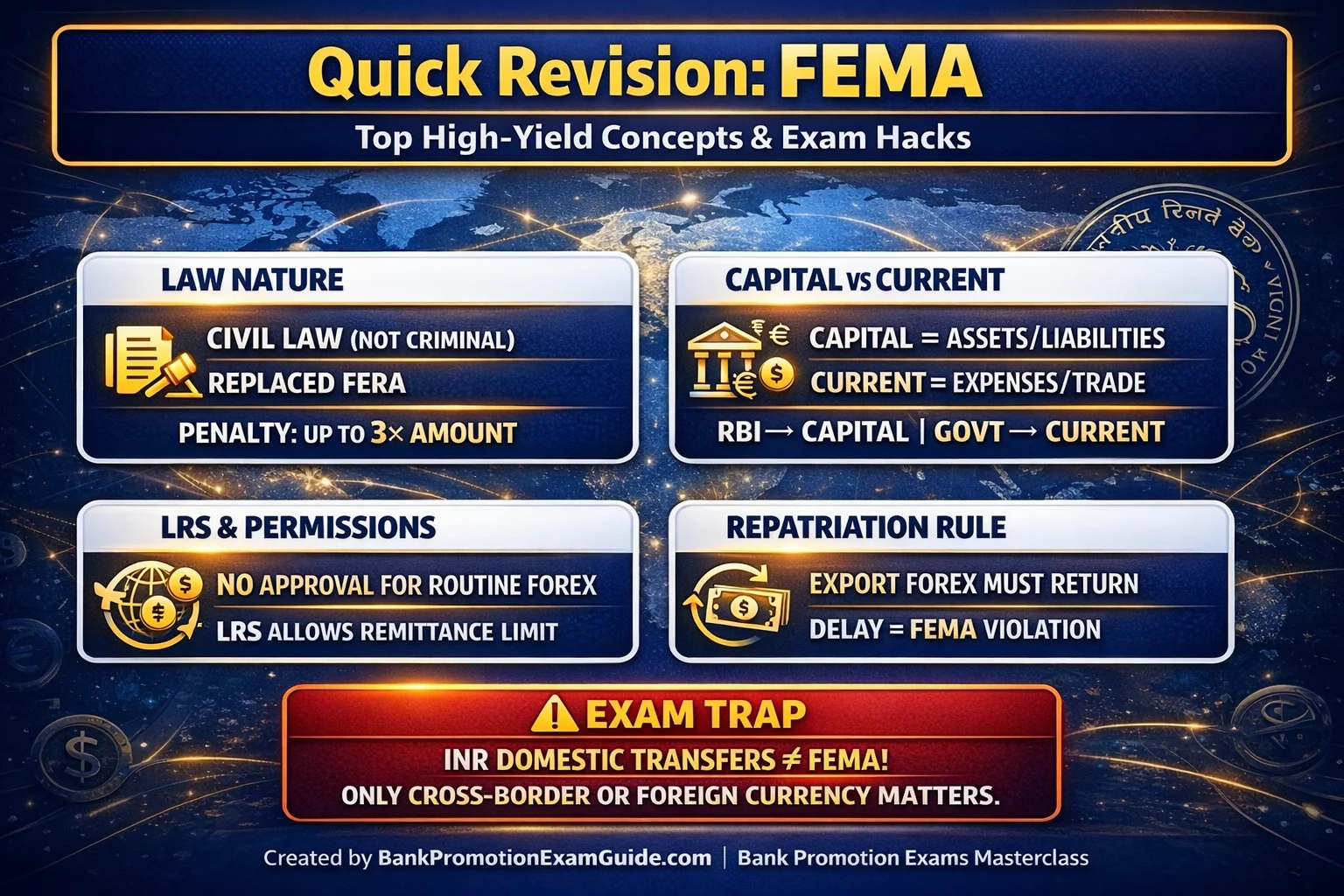
FEMA is a civil law, distinct from its predecessor FERA which was a criminal law. Violations of FEMA are treated as civil contraventions, typically resulting in monetary penalties (fines) which can be up to three times the sum involved in the contravention. Imprisonment is not the default punishment; it arises only if the penalty is not paid. Citizenship cancellation is not a penalty under this Act.
▶ Watch Video Explanation
A resident of Bengaluru transfers ₹75,000 via UPI, to a friend's bank account in Kolkata. Both accounts are held in Indian banks, and denominated in Indian Rupees. Why does this transaction NOT fall under the purview of FEMA?
Explanation:
Correct: B
FEMA regulates "foreign exchange" and transactions involving foreign currency or cross-border flows. A transfer of Indian Rupees (INR) between two resident bank accounts within India is a domestic transaction. It does not involve foreign currency or assets outside India, so FEMA has no jurisdiction over it.
▶ Watch Video Explanation
Which of the following statements, regarding the objectives and philosophy of FEMA, are correct?
1. FEMA aims to facilitate external trade, and payments.
2. The Act is designed to promote the orderly development, and maintenance of the foreign exchange market in India.
3. FEMA represents a shift in philosophy, from "conservation and control" of forex, to "management" of forex.
4. FEMA bans all personal foreign exchange transactions, to preserve national reserves.
1. FEMA aims to facilitate external trade, and payments.
2. The Act is designed to promote the orderly development, and maintenance of the foreign exchange market in India.
3. FEMA represents a shift in philosophy, from "conservation and control" of forex, to "management" of forex.
4. FEMA bans all personal foreign exchange transactions, to preserve national reserves.
Explanation:
Correct: C
FEMA replaced the older FERA legislation. The shift was from strict "control" (policing) to "management" (facilitation). Its stated objectives include facilitating external trade and payments and promoting the "orderly development" of the forex market. Statement 4 is incorrect because FEMA does not ban personal transactions; it allows them under specific schemes like the Liberalised Remittance Scheme (LRS).
▶ Watch Video Explanation
An individual has been living and working in Mumbai, for the last five years. While on a trip abroad, she purchases a property in Dubai, in her own name. Does FEMA apply to this asset?
Explanation:
Correct: C
FEMA has extraterritorial jurisdiction regarding residents. It applies to the whole of India and also applies to all branches, offices, and agencies outside India owned or controlled by a person resident in India. Crucially, if a person is a "person resident in India," they are subject to FEMA regulations regarding their global assets, including foreign bank accounts and property.
▶ Watch Video Explanation
Which regulatory body is primarily responsible, for the administration and practical implementation of the Foreign Exchange Management Act (FEMA), including issuing Master Directions to banks?
Explanation:
Correct: A
The Reserve Bank of India (RBI) is the central authority for administering FEMA. While the Central Government formulates the rules, the RBI issues regulations, Master Directions, and circulars that Authorized Dealer banks must follow. It manages the day-to-day operation of the foreign exchange market.
▶ Watch Video Explanation
Advertisement
Consider the following scenarios, regarding residential status under FEMA:
1. Mr. A stayed in India for 200 days in the preceding financial year, and has no employment abroad. He is considered a Person Resident in India.
2. Ms. B left India on July 1st, to take up employment in London for 3 years. She is considered a Person Resident Outside India, from the date of her departure.
3. Mr. C lives in India, but is a US citizen. Citizenship determines his status under FEMA, so he is a Person Resident Outside India.
Which of the statements above, are correct?
1. Mr. A stayed in India for 200 days in the preceding financial year, and has no employment abroad. He is considered a Person Resident in India.
2. Ms. B left India on July 1st, to take up employment in London for 3 years. She is considered a Person Resident Outside India, from the date of her departure.
3. Mr. C lives in India, but is a US citizen. Citizenship determines his status under FEMA, so he is a Person Resident Outside India.
Which of the statements above, are correct?
Explanation:
Correct: A
Statement 1 is correct: The primary test for residence is staying in India for more than 182 days in the preceding financial year. Statement 2 is correct: There is an exception to the 182-day rule. If a person leaves India for taking up employment abroad, they become a Person Resident Outside India immediately upon departure. Statement 3 is incorrect: FEMA looks at residential status, not citizenship. A US citizen living in India long-term is a Person Resident in India under FEMA.
▶ Watch Video Explanation
Consider the following foreign exchange transactions, undertaken by Indian residents.
Which of the following correctly classifies the nature of the transaction, under FEMA?
1. Sending money abroad, for a son's university tuition fee: Current Account Transaction.
2. Buying shares of a company listed on the New York Stock Exchange: Capital Account Transaction.
3. Opening a fixed deposit in US Dollars, with a bank in London: Current Account Transaction.
4. Paying for a personal holiday in Europe: Capital Account Transaction.
Which of the following correctly classifies the nature of the transaction, under FEMA?
1. Sending money abroad, for a son's university tuition fee: Current Account Transaction.
2. Buying shares of a company listed on the New York Stock Exchange: Capital Account Transaction.
3. Opening a fixed deposit in US Dollars, with a bank in London: Current Account Transaction.
4. Paying for a personal holiday in Europe: Capital Account Transaction.
Explanation:
Correct: A
Under FEMA, a Current Account Transaction is one that does not alter assets or liabilities outside India (e.g., tuition fees, travel expenses, trade payments). A Capital Account Transaction is one that alters assets or liabilities outside India (e.g., buying shares/property abroad, opening foreign bank accounts). Therefore, Statement 1 is correct (Tuition = Current) and Statement 2 is correct (Shares = Capital/Asset creation). Statement 3 is incorrect because opening a deposit creates an asset abroad, making it a Capital Account transaction. Statement 4 is incorrect because travel is an expense, making it a Current Account transaction.
▶ Watch Video Explanation
Regarding the regulation of foreign exchange transactions,
which of the following pairs correctly identifies the primary regulatory authority?
which of the following pairs correctly identifies the primary regulatory authority?
Explanation:
Correct: B
FEMA establishes a distinct division of regulatory power. The Reserve Bank of India (RBI) primarily regulates Capital Account transactions (in consultation with the Government). The Central Government primarily frames the rules for Current Account transactions (in consultation with the RBI).
▶ Watch Video Explanation
Under FEMA, the term "Foreign Exchange" includes
which of the following?
which of the following?
An individual wishes to legally purchase US Dollars, for a holiday abroad. Under FEMA, from whom must they purchase this currency?
Advertisement
The "Liberalised Remittance Scheme" (LRS) allows residents to remit a certain amount of money abroad annually, for permitted purposes, without seeking case-by-case approval. What FEMA principle does this illustrate?
An Indian exporter ships goods to a buyer in France, but fails to collect the payment within the time period prescribed by the RBI. The exporter claims that since the goods have left India, FEMA no longer applies. Is this correct?
The Reserve Bank of India (RBI) issues a Master Direction, requiring Authorized Dealer (AD) banks to obtain specific documentation, for certain outward remittances.
What is the legal standing of this direction?
What is the legal standing of this direction?
An individual realizes they have inadvertently committed a technical contravention, of FEMA procedures. They wish to voluntarily admit the error, and pay a monetary settlement to close the matter, without facing lengthy litigation. Which facility under FEMA allows this?
Consider the following statements, regarding penalties and recovery under FEMA:
1. If the amount involved in a contravention is quantifiable, the penalty can be up to three times, the sum involved.
2. If a penalty is not paid within the prescribed time, the enforcement authority has the power to seize property, or assets of equivalent value.
3. The standard penalty for all FEMA violations, is a fixed fine of ₹5,000, regardless of the amount involved.
4. Non-payment of penalties, automatically results in the cancellation of the defaulter's Indian citizenship.
Which of the statements above, are correct?
1. If the amount involved in a contravention is quantifiable, the penalty can be up to three times, the sum involved.
2. If a penalty is not paid within the prescribed time, the enforcement authority has the power to seize property, or assets of equivalent value.
3. The standard penalty for all FEMA violations, is a fixed fine of ₹5,000, regardless of the amount involved.
4. Non-payment of penalties, automatically results in the cancellation of the defaulter's Indian citizenship.
Which of the statements above, are correct?
Advertisement
Which of the following statements, correctly describe the enforcement and appellate structure under FEMA?
1. The Directorate of Enforcement (ED), is the primary agency responsible for investigating contraventions, and enforcing the provisions of the Act.
2. Appeals against orders passed by an Adjudicating Authority, lie first to the Special Director (Appeals) in specific cases, rather than directly to the High Court.
3. SEBI is the primary agency, for investigating foreign exchange violations by private limited companies.
4. All appeals against FEMA penalties, must go directly to the Supreme Court of India.
1. The Directorate of Enforcement (ED), is the primary agency responsible for investigating contraventions, and enforcing the provisions of the Act.
2. Appeals against orders passed by an Adjudicating Authority, lie first to the Special Director (Appeals) in specific cases, rather than directly to the High Court.
3. SEBI is the primary agency, for investigating foreign exchange violations by private limited companies.
4. All appeals against FEMA penalties, must go directly to the Supreme Court of India.
Which of the following pairs, correctly matches the Section of the Foreign Exchange Management Act (FEMA), with its specific subject matter?
1. Section 3: Prohibition on dealing in foreign exchange, except through an Authorized Person.
2. Section 6: Regulation of Capital Account Transactions.
3. Section 7: Export of Goods and Services (Realization and Repatriation).
4. Section 10: Regulation of Domestic Rupee Transfers.
1. Section 3: Prohibition on dealing in foreign exchange, except through an Authorized Person.
2. Section 6: Regulation of Capital Account Transactions.
3. Section 7: Export of Goods and Services (Realization and Repatriation).
4. Section 10: Regulation of Domestic Rupee Transfers.
A person resident in India, wishes to open a savings bank account in New York, denominated in US Dollars. Under FEMA, is this permitted?
An Indian parent company, provides a corporate guarantee to a foreign bank, to secure a loan for its overseas subsidiary. How is this transaction classified under FEMA?
Looking for the most important FEMA MCQs for your upcoming exams? We have analyzed past papers for Bank Promotion Exams to bring you the 19 most expected questions on the Foreign Exchange Management Act. Take the live test, review the blueprint, and master the core concepts.
- 🚀 Updated for 2026: Aligned with the latest Bank Promotion Exams syllabus.
- 🧠 Output & Concept Based: Covers basics to advanced scenarios.
- 📊 Live Gamification: Track your score and time dynamically.
- 📥 Free PDF Notes: Available instantly via our Telegram channel.
Test Blueprint & Topic Weightage
| Introduction, Scope and Residential Status | Q1 – Q6 | Easy to Medium |
| Transactions, Facilities and Authorized Persons | Q7 – Q12 | Medium |
| Penalties, Adjudication and Sections | Q13 – Q19 | Hard |
⚠️ Examiner Trap Alert: Examiners frequently trap students by disguising asset-creating transactions (like opening a fixed deposit abroad) as standard expenses. Remember, if a transaction alters assets or liabilities outside India, it is strictly a Capital vs Current Account classification issue—specifically, it is a Capital Account Transaction.
Practice FEMA MCQs (Live Mock Test)
⏱️ Estimated Time: 28.5 Minutes | 🎯 Target Score: 15+ | 📊 Difficulty: Moderate to Hard
High-Yield Core Concepts
Civil Liability: FEMA is a civil law focused on management. Contraventions result in monetary penalties (up to 3x the amount) rather than automatic imprisonment.
Residential Status: Status relies heavily on the 182-days rule and intention. However, leaving India for employment abroad immediately changes your status to a Person Resident Outside India.
General Permission: Routine forex transfers are deemed approved up to certain limits without seeking RBI case-by-case approval, as heavily tested in the Liberalised Remittance Scheme (LRS) limits.
Authorized Channels: Section 3 explicitly bans dealing in foreign exchange through informal channels. You must exclusively purchase or sell foreign currency through an RBI-licensed Authorized Dealer.
Semantic Comparison: FEMA vs FERA
| Core Definition | Civil law focused on the management of foreign exchange | Criminal law focused on the strict control of foreign exchange |
| Primary Use Case | Facilitating external trade and promoting orderly forex markets | Conserving foreign exchange reserves strictly |
| Exam Importance | Essential for current banking operations and cross-border compliance | Essential only for historical context of banking laws |
Frequently Asked Questions
Why are FEMA MCQs critical for Bank Promotion Exams?
It is a consistently high-scoring area. Examiners frequently repeat core concepts from this section, especially regarding the classification of capital versus current account transactions and penalty limits.
Does this mock test cover the full syllabus?
Yes, these questions target the most highly-weighted concepts found in previous years’ papers, covering everything from residential status to the compounding of contraventions.
What are the most repeated topics?
Based on our blueprint, Penalties and Adjudication, along with the rules for Authorized Persons, carry the highest weightage.