⚠️ Content Protected
Join our Telegram for PDF: t.me/BankPromotionExamGuide
SARFAESI Act MCQs – 19 Most Expected Questions ⏳ Updated: Apr 2026 | 🎯 18 MCQs
⚠️ Select an answer!
Which of the following statements are correct regarding the identity and enactment of the SARFAESI Act?
1. The full form of the Act is "Securitisation and Reconstruction of Financial Assets and Enforcement of Security Interest Act".
2. The Act was enacted by the Parliament of India in the year 2002.
1. The full form of the Act is "Securitisation and Reconstruction of Financial Assets and Enforcement of Security Interest Act".
2. The Act was enacted by the Parliament of India in the year 2002.
Explanation:
Correct: C
The SARFAESI Act (Act 54 of 2002) stands for "Securitisation and Reconstruction of Financial Assets and Enforcement of Security Interest Act." It was enacted in 2002 to provide a legal framework for the enforcement of security interest without court intervention.
▶ Watch Video Explanation
Which of the following statements are correct regarding the applicability and scope of the SARFAESI Act?
1. The measures under this Act can only be initiated against loans that are classified as "secured loans" backed by security interest.
2. The provisions of this Act explicitly allow banks to enforce security interest created on agricultural land.
1. The measures under this Act can only be initiated against loans that are classified as "secured loans" backed by security interest.
2. The provisions of this Act explicitly allow banks to enforce security interest created on agricultural land.
Explanation:
Correct: A
Statement 1 is correct; the Act applies only to secured loans where a security interest exists. Statement 2 is incorrect because Section 31 of the SARFAESI Act specifically exempts agricultural land from the provisions of the Act, meaning banks cannot enforce security interest on farm land under this law.
▶ Watch Video Explanation
Consider the following statements regarding the enforcement process under Section 13 of the SARFAESI Act:
1. The secured creditor must issue a demand notice giving the borrower 60 days to discharge their liability.
2. If the borrower submits an objection to the notice, the secured creditor must communicate their response within 15 days.
3. If the borrower fails to repay within the notice period, the creditor may take possession of the secured asset under Section 13(4).
Which of the statements given above are correct?
1. The secured creditor must issue a demand notice giving the borrower 60 days to discharge their liability.
2. If the borrower submits an objection to the notice, the secured creditor must communicate their response within 15 days.
3. If the borrower fails to repay within the notice period, the creditor may take possession of the secured asset under Section 13(4).
Which of the statements given above are correct?
Explanation:
Correct: D
The standard procedure under Section 13 involves three key steps: issuing a 60-day demand notice under Section 13(2), replying to any borrower representations within 15 days under Section 13(3A), and taking recourse to measures like possession under Section 13(4) if the dues remain unpaid.
▶ Watch Video Explanation
Under the SARFAESI Act framework, the classification of a borrower's account as a "Non-Performing Asset" (NPA) is a mandatory prerequisite for enforcement. Which authority issues the guidelines for this classification?
Explanation:
Correct: B
The SARFAESI Act relies on the definition of Non-Performing Assets (NPA) as declared by the Reserve Bank of India (RBI). Banks must follow the prudential norms issued by the RBI to classify an account as NPA before initiating action under this Act.
▶ Watch Video Explanation
The SARFAESI Act prescribes a specific monetary threshold below which the provisions of the Act cannot be invoked.
What is the minimum outstanding loan amount required for a bank to initiate action under this Act?
What is the minimum outstanding loan amount required for a bank to initiate action under this Act?
Explanation:
Correct: C
According to Section 31(h) of the SARFAESI Act, the provisions of the Act do not apply to any security interest created in financial assets for securing repayment of any financial assistance not exceeding one lakh rupees (₹1,00,000).
▶ Watch Video Explanation
Advertisement
To prevent fraud involving multiple loans against the same asset, the SARFAESI Act mandated the creation of a central registry.
Which of the following statements regarding this registry are correct?
1. The registry is known as "CERSAI" (Central Registry of Securitisation Asset Reconstruction and Security Interest of India).
2. Its primary purpose is to maintain a central record of security interests aimed at preventing borrowers from mortgaging the same asset to multiple lenders.
Which of the following statements regarding this registry are correct?
1. The registry is known as "CERSAI" (Central Registry of Securitisation Asset Reconstruction and Security Interest of India).
2. Its primary purpose is to maintain a central record of security interests aimed at preventing borrowers from mortgaging the same asset to multiple lenders.
Explanation:
Correct: C
CERSAI was established under the SARFAESI Act to function as a central registry. Its objective is to record details of security interests created on assets, thereby allowing potential lenders to verify if an asset is free from encumbrances and preventing multiple financing on the same collateral.
▶ Watch Video Explanation
Consider the following statements regarding the rights of a borrower to appeal against enforcement actions taken by a secured creditor under the SARFAESI Act:
1. Any person aggrieved by the measures taken under Section 13(4) may file an application to the Debt Recovery Tribunal (DRT) within 45 days.
2. A further appeal to the Debt Recovery Appellate Tribunal (DRAT) can be entertained only if the borrower deposits at least 50% of the debt amount due (reducible to 25%).
Which of the statements given above are correct?
1. Any person aggrieved by the measures taken under Section 13(4) may file an application to the Debt Recovery Tribunal (DRT) within 45 days.
2. A further appeal to the Debt Recovery Appellate Tribunal (DRAT) can be entertained only if the borrower deposits at least 50% of the debt amount due (reducible to 25%).
Which of the statements given above are correct?
Explanation:
Correct: C
Section 17 allows a borrower to approach the DRT within 45 days of the bank taking measures under Section 13(4). Section 18 allows a further appeal to the DRAT, but it carries a strict pre-condition: the borrower must deposit 50% of the debt due as determined by the DRT (which the Tribunal may reduce to not less than 25%).
▶ Watch Video Explanation
The SARFAESI Act establishes a specific legal framework for debt recovery.
Which of the following statements correctly describe its legal supremacy and jurisdiction?
1. Civil Courts have full jurisdiction to entertain suits regarding matters that the Debt Recovery Tribunal (DRT) is empowered to determine.
2. The provisions of the SARFAESI Act have an overriding effect over any other law that is inconsistent with it.
Which of the following statements correctly describe its legal supremacy and jurisdiction?
1. Civil Courts have full jurisdiction to entertain suits regarding matters that the Debt Recovery Tribunal (DRT) is empowered to determine.
2. The provisions of the SARFAESI Act have an overriding effect over any other law that is inconsistent with it.
Explanation:
Correct: B
Statement 1 is incorrect because Section 34 specifically bars Civil Courts from entertaining any suit or proceeding in respect of any matter which the DRT or DRAT is empowered to determine. Statement 2 is correct as Section 35 provides that the Act shall have effect notwithstanding anything inconsistent therewith contained in any other law.
▶ Watch Video Explanation
When a secured creditor proceeds to sell an immovable property under the SARFAESI Act, they must adhere to specific procedural safeguards.
Which of the following statements regarding this process are correct?
1. Before the sale, the authorized officer must obtain a valuation of the property from an approved valuer.
2. A sale notice must be published in two leading newspapers, one of which must be in the vernacular language of the locality.
3. Any surplus amount realized from the sale, after satisfying the debt and costs, must be returned to the borrower.
Which of the following statements regarding this process are correct?
1. Before the sale, the authorized officer must obtain a valuation of the property from an approved valuer.
2. A sale notice must be published in two leading newspapers, one of which must be in the vernacular language of the locality.
3. Any surplus amount realized from the sale, after satisfying the debt and costs, must be returned to the borrower.
Asset Reconstruction Companies (ARCs) play a vital role in the ecosystem of bad loan management.
Which of the following statements correctly describe their regulatory status and functions?
1. ARCs must be registered with and are regulated by the Reserve Bank of India (RBI).
2. For the purpose of raising funds to acquire financial assets, ARCs can issue "Security Receipts" to qualified buyers.
Which of the following statements correctly describe their regulatory status and functions?
1. ARCs must be registered with and are regulated by the Reserve Bank of India (RBI).
2. For the purpose of raising funds to acquire financial assets, ARCs can issue "Security Receipts" to qualified buyers.
Advertisement
In cases of consortium lending where multiple banks have financed a single borrower, enforcement action under the SARFAESI Act requires consensus.
What is the minimum percentage of secured creditors (by value) that must agree to initiate such action?
What is the minimum percentage of secured creditors (by value) that must agree to initiate such action?
Section 13(4) of the SARFAESI Act grants secured creditors various powers to recover their dues.
Which of the following actions is NOT permitted to the creditor under this section?
Which of the following actions is NOT permitted to the creditor under this section?
Under the proposed Section 31A of the SARFAESI Act, specific power is granted to exempt certain classes of banks or financial institutions from the application of the Act. Which authority is empowered to issue such notifications?
The Central Registry (CERSAI) serves as a critical infrastructure for secured lending in India.
Which of the following statements regarding its operational rules are correct?
1. The records maintained by the Central Registry are open for inspection by any person on payment of a prescribed fee.
2. In cases where multiple security interests are created on the same asset, priority of claim is generally determined by the date of registration with the Central Registry.
Which of the following statements regarding its operational rules are correct?
1. The records maintained by the Central Registry are open for inspection by any person on payment of a prescribed fee.
2. In cases where multiple security interests are created on the same asset, priority of claim is generally determined by the date of registration with the Central Registry.
The implementation of enforcement measures under the SARFAESI Act involves specific procedural roles and notices.
Which of the following statements are correct?
1. The auction and sale of secured assets are conducted by a designated "Authorised Officer" acting on behalf of the bank.
2. When a bank takes physical control of an asset, a "Possession Notice" must be affixed on the property to inform the public and the borrower of the bank's action.
Which of the following statements are correct?
1. The auction and sale of secured assets are conducted by a designated "Authorised Officer" acting on behalf of the bank.
2. When a bank takes physical control of an asset, a "Possession Notice" must be affixed on the property to inform the public and the borrower of the bank's action.
Advertisement
Under the SARFAESI Act, the enforcement of security interest can involve different modes of taking possession.
Which of the following statements correctly distinguish between "Symbolic Possession" and "Physical Possession"?
1. Symbolic Possession occurs when the bank issues a possession notice and publishes it, but the borrower continues to occupy the property.
2. Physical Possession involves the bank taking actual custody and control of the property, often to the exclusion of the borrower.
Which of the following statements correctly distinguish between "Symbolic Possession" and "Physical Possession"?
1. Symbolic Possession occurs when the bank issues a possession notice and publishes it, but the borrower continues to occupy the property.
2. Physical Possession involves the bank taking actual custody and control of the property, often to the exclusion of the borrower.
The sale of secured assets under SARFAESI involves specific documentation and transparency norms.
Which of the following statements are correct?
1. To ensure fairness, the authorized officer must notify the borrower of the property's valuation and reserve price before the auction.
2. Upon the successful conclusion of the auction and payment of the full price, the bank issues a "Sale Certificate" to the purchaser as proof of transfer of title.
Which of the following statements are correct?
1. To ensure fairness, the authorized officer must notify the borrower of the property's valuation and reserve price before the auction.
2. Upon the successful conclusion of the auction and payment of the full price, the bank issues a "Sale Certificate" to the purchaser as proof of transfer of title.
When a borrower files an application (appeal) before the Debt Recovery Tribunal (DRT) challenging the bank's action under the SARFAESI Act,
what is the immediate legal effect on the bank's enforcement proceedings?
what is the immediate legal effect on the bank's enforcement proceedings?
Looking for the most important SARFAESI Act MCQs for your upcoming exams? We have analyzed past papers for Bank Promotion Exams to bring you the 19 most expected questions. Take the live test, review the blueprint, and master the core concepts.
- 🚀 Updated for 2026: Aligned with the latest Bank Promotion Exams syllabus.
- 🧠 Output & Concept Based: Covers basics to advanced scenarios.
- 📊 Live Gamification: Track your score and time dynamically.
- 📥 Free PDF Notes: Available instantly via our Telegram channel.
Test Blueprint & Topic Weightage
| Introduction and Definitions | Q1 – Q5 | Easy to Medium |
| Enforcement and Appeals | Q6 – Q10 | Medium |
| Operational Procedures & Miscellaneous | Q11 – Q19 | Hard |
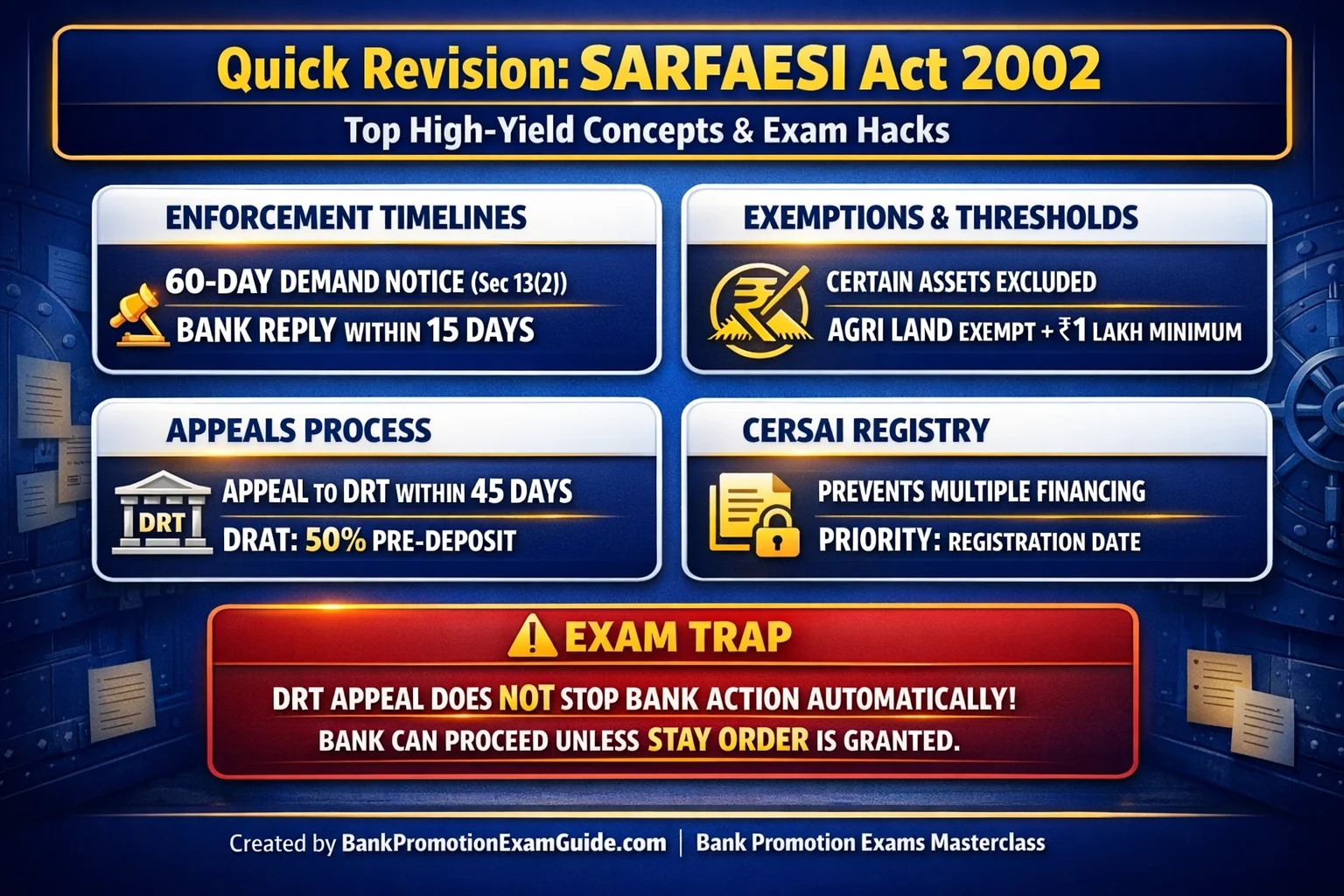
⚠️ Examiner Trap Alert: A common examiner trick is the “Automatic Stay” assumption. Students often mistakenly believe that simply filing an appeal with the DRT automatically stays the bank’s recovery proceedings. Legally, there is no automatic stay; the bank can continue enforcement unless the Tribunal explicitly issues an interim stay order.
Practice SARFAESI Act MCQs (Live Mock Test)
⏱️ Estimated Time: 28.5 Minutes | 🎯 Target Score: 15+ | 📊 Difficulty: Moderate to Hard
High-Yield Core Concepts
Applicability & Exemptions: The Act allows direct action on secured loans classified as a Non-Performing Asset, but Section 31 strictly exempts agricultural land.
Demand Notice Process: Banks must issue a 60-day demand notice under Section 13(2), and reply to any borrower objections within 15 days before issuing a Possession Notice.
Strict Appeals Protocol: Borrowers can appeal to the Debt Recovery Tribunal within 45 days, but any further appeal to the DRAT requires a mandatory 50% pre-deposit of the debt due.
Fraud Prevention: The Central Registry (CERSAI) maintains records of security interests to prevent multiple financing frauds and determines priority of claims based on registration dates.
Semantic Comparison: SARFAESI Act vs DRT Act
| Core Definition | Non-judicial recovery mechanism for secured assets | Judicial recovery mechanism via specialized tribunals |
| Primary Use Case | Taking direct possession/sale of mortgaged property | Filing recovery suits for both secured and unsecured debts |
| Exam Importance | Essential for asset recovery operations | Essential for understanding legal litigation processes |
Frequently Asked Questions
Why are SARFAESI Act MCQs critical for Bank Promotion Exams?
It is a consistently high-scoring area. Examiners frequently repeat core concepts from this section, especially timelines, DRT appeal structures, and operational procedures.
Does this mock test cover the full syllabus?
Yes, these questions target the most highly-weighted concepts found in previous years’ papers, covering everything from Section 13 notices to ARC guidelines.
What are the most repeated topics?
Based on our blueprint, Enforcement and Appeals (like CERSAI and DRT guidelines) and Operational Procedures carry the highest weightage.