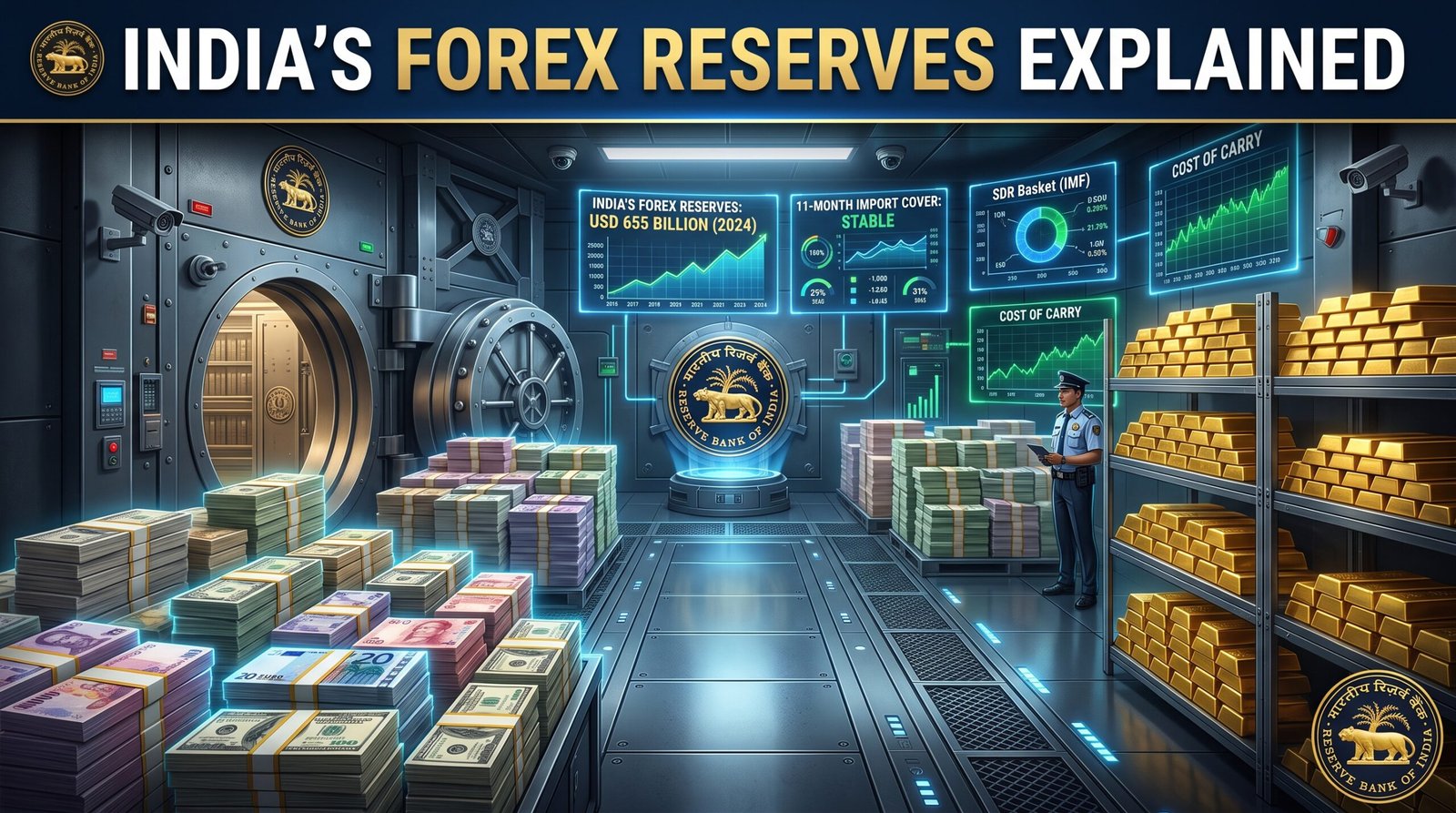
India’s forex reserves Explained Updated: Aug 2026 | 🎯 28 MCQs

⚠️ Content Protected

Join our Telegram for PDF: t.me/BankPromotionExamGuide

India's forex reserves Explained Updated: Aug 2026 | 🎯 28 MCQs

Q 1 / 28
Which of the following correctly identifies the four components of India's foreign exchange reserves and its largest constituent?
A. Foreign Currency Assets (FCA), Gold, SDRs, and Reserve Tranche Position (RTP), with Gold being the largest.
B. Foreign Currency Assets (FCA), Gold, SDRs, and Reserve Tranche Position (RTP), with FCA being the largest.
C. Foreign Direct Investment (FDI), Gold, SDRs, and IMF Loans, with FDI being the largest.
D. Foreign Currency Assets (FCA), Sovereign Wealth Funds, SDRs, and RTP, with FCA being the largest.
How are India's foreign exchange reserves legally classified in terms of ownership and accounting?
A. They are held as consolidated funds owned directly by the Ministry of Finance.
B. They are classified as liabilities on the balance sheet of the International Monetary Fund (IMF).
C. They are maintained as trust funds by the State Bank of India on behalf of the Government.
D. They are recorded as assets strictly on the balance sheet of the Reserve Bank of India (RBI).
Which legislation provides the principal statutory framework empowering the Reserve Bank of India (RBI) to act as the custodian and manager of India's foreign exchange reserves?
A. The Banking Regulation Act, 1949
B. The Securities Contracts (Regulation) Act, 1956
C. The Reserve Bank of India Act, 1934
D. The Payment and Settlement Systems Act, 2007
What exactly are the Special Drawing Rights (SDRs) included in India's foreign exchange reserves?
A. They are a physical fiat currency issued globally by the World Bank.
B. They are gold-backed certificates issued exclusively by the Bank for International Settlements.
C. They are an international reserve asset created by the IMF based on a basket of major currencies.
D. They are bilateral credit lines extended by the United States Federal Reserve to the RBI.
Which specific mechanism, launched by the RBI in June 2026, significantly boosted India's foreign exchange reserves to nearly $693 billion by the end of July 2026 amidst global volatility?
A. The monetization of domestic sovereign gold bonds into physical gold reserves.
B. The Foreign Currency Non-Resident (Bank) or FCNR(B) deposit incentive scheme.
C. A sovereign dollar bond issuance directly in the United States treasury market.
D. The mandatory conversion of all non-resident rupee accounts into US dollars.
In May 2026, the Reserve Bank of India (RBI) approved a historic surplus transfer (dividend) of ₹2.11 lakh crore to the Union Government.

Which of the following factors was the primary driver of this massive surplus generation from its balance sheet?
A. The liquidation and sale of physical gold reserves held domestically
B. Higher interest yields earned on its Foreign Currency Assets (FCA) parked in US Treasuries and foreign sovereign bonds
C. Direct grants received from the IMF under the Special Drawing Rights (SDR) allocation scheme
D. The mandatory conversion of commercial bank statutory liquidity ratio (SLR) funds into foreign equity
The RBI periodically assesses the adequacy of India's foreign exchange reserves using a metric known as the "Import Cover." What exactly does this metric measure?
A. The total value of imported gold that is used to back the domestic currency printing
B. The percentage of foreign exchange reserves that are strictly earmarked for petroleum and defense imports
C. The number of months of merchandise imports that can be financed by the current total forex reserves
D. The ratio of essential imports to non-essential imports permitted under the Foreign Exchange Management Act
Under the statutory guidelines governing the deployment of India's foreign exchange reserves, in

which of the following asset classes is the Reserve Bank of India (RBI) strictly PROHIBITED from investing its Foreign Currency Assets (FCA)?
A. Sovereign debt instruments issued by foreign governments
B. Deposits with the Bank for International Settlements (BIS)
C. Foreign equities and high-yield corporate bonds
D. Deposits with top-tier foreign commercial banks
When the RBI aggressively purchases foreign currency (such as the massive inflows seen in July 2026) to add to its forex reserves, it injects a massive amount of Rupee liquidity into the domestic market. Which tool is primarily used by the RBI to absorb this excess liquidity and prevent inflation?
A. Expanding the issuance of Sovereign Gold Bonds (SGBs)
B. The Market Stabilization Scheme (MSS) and Open Market Operations (OMOs)
C. Increasing the export quotas under the national Foreign Trade Policy
D. The Foreign Currency Non-Resident (Bank) deposit scheme
The Reserve Tranche Position (RTP) is a key component of India's forex reserves held at the International Monetary Fund (IMF). How is a member country's RTP mathematically and structurally defined?
A. The sum of the country's SDR allocation and its total external commercial borrowings
B. The difference between the country's total IMF quota and the IMF's holdings of that country's domestic currency
C. The total value of foreign currency structural adjustment loans provided by the IMF to the country
D. The fixed percentage of physical gold deposited by the country with the IMF headquarters
In May 2026, the Reserve Bank of India (RBI) executed a major logistical operation to repatriate approximately 100 metric tonnes of its gold reserves from the Bank of England to its domestic vaults in Mumbai and Nagpur.

What is the primary strategic macroeconomic reason for central banks like the RBI to shift gold reserves domestically?
A. To melt the gold and issue physical gold-backed sovereign currency to combat domestic hyperinflation
B. To mitigate geopolitical risks, prevent potential asset freezing by foreign governments, and reduce overseas storage fees
C. To pledge the physical gold as direct collateral for securing short-term commercial loans from the World Bank
D. To distribute the physical gold into the domestic retail market to artificially lower the fiscal deficit
The RBI actively intervenes in the currency markets to curb excessive volatility in the Indian Rupee.

Which of the following mechanisms allows the RBI to defend a depreciating Rupee without immediately depleting its headline "Spot" Foreign Exchange Reserves?
A. Liquidating its entire holding of Special Drawing Rights (SDRs) at the IMF
B. Selling US Dollars in the forward market with an agreement to buy them back later
C. Printing unbacked domestic currency and injecting it directly into commercial banks
D. Forcing domestic exporters to instantly convert all their future earnings into physical gold
While the Reserve Bank of India (RBI) Act, 1934 governs the custody and investment of India's forex reserves, which distinct legislative framework primarily regulates the cross-border inflows and outflows of foreign exchange that ultimately build or deplete these reserves?
A. The Banking Regulation Act, 1949
B. The Securities and Exchange Board of India (SEBI) Act, 1992
C. The Foreign Exchange Management Act (FEMA), 1999
D. The Foreign Contribution (Regulation) Act (FCRA), 2010
In macroeconomic discourse, holding massive foreign exchange reserves (such as India's ~$690 billion) incurs a "quasi-fiscal cost" or "cost of carry."

Which of the following best defines this specific cost?
A. The physical transportation and security fees paid to international bullion banks to store gold
B. The interest rate differential between the lower yields earned on foreign sovereign assets and the higher interest paid on domestic bonds used to sterilize those reserves
C. The mandatory annual subscription fees paid in US Dollars to the International Monetary Fund (IMF)
D. The depreciation of the US Dollar against the Euro in global currency markets
The Reserve Bank of India periodically publishes the Net International Investment Position (NIIP), which measures the gap between a nation's stock of foreign financial assets and foreign liabilities. Within India's NIIP,

which of the following constitutes the largest component of its international financial ASSETS?
A. Overseas corporate acquisitions and Foreign Direct Investment (FDI) made by Indian multinational companies
B. Foreign exchange reserves held by the Reserve Bank of India
C. Commercial real estate holdings owned by Non-Resident Indians (NRIs) in the United States and Europe
D. Bilateral development loans extended by the Indian Government to neighboring South Asian nations
🔒 Premium Content Locked

Unlock the Remaining 13 High-Yield MCQs & Explanations

You have reached the end of the free preview. To unblur the remaining questions and reveal the detailed explanations, purchase an access code.

🎟️ Single Post Pass 📚 Exam-Wise Pass 🗓️ Monthly Pass 🌍 Global Pass
The RBI reports India's total foreign exchange reserves in US Dollars on a weekly basis. Often, the headline reserve number increases or decreases by billions of dollars even if the RBI did not buy or sell a single dollar in the market. What primarily causes this phenomenon?
A. The automatic deduction of sovereign debt interest payments by the World Bank.
B. Valuation effects caused by fluctuations in the exchange rates of non-USD currencies (like the Euro and Yen) and the price of gold against the US Dollar.
C. The mandatory weekly conversion of all domestic commercial bank profits into foreign currency.
D. The imposition of variable international tariffs by the World Trade Organization.
🔒 Premium Content Locked

Unlock the Remaining 13 High-Yield MCQs & Explanations

You have reached the end of the free preview. To unblur the remaining questions and reveal the detailed explanations, purchase an access code.

🎟️ Single Post Pass 📚 Exam-Wise Pass 🗓️ Monthly Pass 🌍 Global Pass
When the value of the RBI's foreign currency assets or gold holdings increases due to favorable exchange rate movements, these "unrealized gains" are not treated as divisible profit to be transferred to the government. Instead, under the RBI's accounting framework, where are these specific gains strictly parked?
A. The Consolidated Fund of India
B. The Market Stabilization Scheme (MSS) Corpus
C. The Currency and Gold Revaluation Account (CGRA)
D. The National Investment and Infrastructure Fund (NIIF)
🔒 Premium Content Locked

Unlock the Remaining 13 High-Yield MCQs & Explanations

You have reached the end of the free preview. To unblur the remaining questions and reveal the detailed explanations, purchase an access code.

🎟️ Single Post Pass 📚 Exam-Wise Pass 🗓️ Monthly Pass 🌍 Global Pass
The RBI periodically uses "Buy/Sell FX Swaps" as a liquidity management tool. In a standard USD/INR Buy/Sell swap conducted by the RBI, what are the exact mechanics of the transaction with commercial banks?
A. The RBI buys US Dollars from banks in the spot market and simultaneously agrees to sell the exact same amount of US Dollars back to them at a specified forward rate on a future date.
B. The RBI sells US Dollars in the spot market and simultaneously demands physical gold as collateral from commercial banks.
C. The RBI buys Indian Rupees from foreign central banks and swaps them for Special Drawing Rights (SDRs).
D. The RBI issues sovereign dollar bonds to foreign retail investors and uses the proceeds to buy domestic equity.
🔒 Premium Content Locked

Unlock the Remaining 13 High-Yield MCQs & Explanations

You have reached the end of the free preview. To unblur the remaining questions and reveal the detailed explanations, purchase an access code.

🎟️ Single Post Pass 📚 Exam-Wise Pass 🗓️ Monthly Pass 🌍 Global Pass
Despite possessing nearly $700 billion in forex reserves in 2026, Indian policymakers have consistently rejected proposals to divert a large portion of these funds into a high-risk, high-return Sovereign Wealth Fund (SWF).

What is the primary macroeconomic justification for this cautious approach?
A. India's reserves are primarily built on "borrowed capital" (like FDI, FPI, and NRI deposits) rather than permanent current account surpluses from massive commodity exports.
B. International Monetary Fund (IMF) regulations strictly prohibit developing nations from establishing Sovereign Wealth Funds.
C. Sovereign Wealth Funds are restricted by law to only invest in domestic real estate and agriculture, which yield low returns.
D. The RBI Act explicitly limits the maximum size of India's forex reserves to $500 billion, forcing the excess to be destroyed.
🔒 Premium Content Locked

Unlock the Remaining 13 High-Yield MCQs & Explanations

You have reached the end of the free preview. To unblur the remaining questions and reveal the detailed explanations, purchase an access code.

🎟️ Single Post Pass 📚 Exam-Wise Pass 🗓️ Monthly Pass 🌍 Global Pass
The sheer scale of India's 2026 forex reserves (providing approximately 11 months of import cover) is frequently contrasted by economists against the historic lows of the 1991 Balance of Payments crisis. During the peak of the 1991 crisis, India's forex reserves had plummeted to a level capable of financing imports for approximately how long?
A. 6 months
B. 2 to 3 weeks
C. 2 days
D. 1 year
🔒 Premium Content Locked

Unlock the Remaining 13 High-Yield MCQs & Explanations

You have reached the end of the free preview. To unblur the remaining questions and reveal the detailed explanations, purchase an access code.

🎟️ Single Post Pass 📚 Exam-Wise Pass 🗓️ Monthly Pass 🌍 Global Pass
According to the Reserve Bank of India’s external debt report released in mid-2026, what was the ratio of India's foreign exchange reserves to its total external debt at the end of March 2026?
A. 50.4 per cent
B. 72.3 per cent
C. 90.6 per cent
D. 115.2 per cent
🔒 Premium Content Locked

Unlock the Remaining 13 High-Yield MCQs & Explanations

You have reached the end of the free preview. To unblur the remaining questions and reveal the detailed explanations, purchase an access code.

🎟️ Single Post Pass 📚 Exam-Wise Pass 🗓️ Monthly Pass 🌍 Global Pass
In the currency composition of India's external debt as reported by the RBI for end-March 2026, which two currencies constituted the largest shares, respectively?
A. US Dollar and Japanese Yen
B. US Dollar and Indian Rupee
C. Euro and US Dollar
D. Special Drawing Rights (SDR) and Euro
🔒 Premium Content Locked

Unlock the Remaining 13 High-Yield MCQs & Explanations

You have reached the end of the free preview. To unblur the remaining questions and reveal the detailed explanations, purchase an access code.

🎟️ Single Post Pass 📚 Exam-Wise Pass 🗓️ Monthly Pass 🌍 Global Pass
In the Reserve Bank of India's weekly statistical supplement, Foreign Currency Assets (FCA) explicitly EXCLUDE certain specialized external financial flows and commitments.

Which of the following is NOT included within FCA?
A. US Treasury bonds and foreign sovereign debt securities
B. Amounts lent under SAARC and Asian Clearing Union (ACU) currency swap arrangements
C. Deposits maintained with top-rated foreign commercial banks
D. Deposits placed with the Bank for International Settlements (BIS)
🔒 Premium Content Locked

Unlock the Remaining 13 High-Yield MCQs & Explanations

You have reached the end of the free preview. To unblur the remaining questions and reveal the detailed explanations, purchase an access code.

🎟️ Single Post Pass 📚 Exam-Wise Pass 🗓️ Monthly Pass 🌍 Global Pass
According to the RBI's external debt statistics for end-March 2026, which institutional category accounted for the largest share of India's external debt?
A. The General Government
B. Central Bank (RBI) direct liabilities
C. Non-financial corporations (Private sector)
D. Other financial corporations
🔒 Premium Content Locked

Unlock the Remaining 13 High-Yield MCQs & Explanations

You have reached the end of the free preview. To unblur the remaining questions and reveal the detailed explanations, purchase an access code.

🎟️ Single Post Pass 📚 Exam-Wise Pass 🗓️ Monthly Pass 🌍 Global Pass
The "Debt Service Ratio" is a key indicator of external vulnerability published in the RBI's external debt reports. How did India's debt service ratio move between end-March 2025 and end-March 2026?
A. It surged from 5.8% to 12.4% due to global interest rate hikes.
B. It remained stagnant at exactly 10.0%.
C. It improved (declined) from 6.6% to 5.8%.
D. It rose exponentially past 25.0%, crossing the IMF danger threshold.
🔒 Premium Content Locked

Unlock the Remaining 13 High-Yield MCQs & Explanations

You have reached the end of the free preview. To unblur the remaining questions and reveal the detailed explanations, purchase an access code.

🎟️ Single Post Pass 📚 Exam-Wise Pass 🗓️ Monthly Pass 🌍 Global Pass
In April 2026, a major 3-year $5 billion USD/INR sell/buy swap executed by the RBI reached maturity. Instead of rolling it over, the RBI opted to take physical delivery of the dollars.

What is the immediate structural impact of taking delivery on the RBI's balance sheet and the domestic market?
A. It immediately decreases the headline foreign exchange reserves.
B. It permanently boosts the spot foreign exchange reserves and injects equivalent Rupee liquidity into the banking system.
C. It converts the dollars directly into Special Drawing Rights (SDRs) at the IMF.
D. It absorbs Rupee liquidity from the market and transfers it to the Consolidated Fund of India.
🔒 Premium Content Locked

Unlock the Remaining 13 High-Yield MCQs & Explanations

You have reached the end of the free preview. To unblur the remaining questions and reveal the detailed explanations, purchase an access code.

🎟️ Single Post Pass 📚 Exam-Wise Pass 🗓️ Monthly Pass 🌍 Global Pass
Apart from the headline foreign exchange reserves, the RBI maintains "secondary lines of defense" to manage temporary dollar shortages.

Which of the following represents a major non-FCA buffer available to India, such as the $75 billion agreement signed with Japan?
A. Bilateral Currency Swap Agreements
B. Sovereign Wealth Equity Grants
C. The Asian Development Bank (ADB) Infrastructure Fund
D. The World Bank Pandemic Bond Facility
🔒 Premium Content Locked

Unlock the Remaining 13 High-Yield MCQs & Explanations

You have reached the end of the free preview. To unblur the remaining questions and reveal the detailed explanations, purchase an access code.

🎟️ Single Post Pass 📚 Exam-Wise Pass 🗓️ Monthly Pass 🌍 Global Pass
In assessing the adequacy of India's foreign exchange reserves, economists frequently reference the "Guidotti-Greenspan rule." According to this standard macroeconomic rule,

what is the minimum threshold a country's reserves should cover?
A. 100% of the country's total external debt across all maturities
B. 100% of the country's short-term external debt maturing within one year
C. At least 3 years of equivalent merchandise imports
D. 50% of the total market capitalization of the domestic stock exchange
Rate this: Avg 0.0 (0 votes)

India's forex reserves

Understanding India’s forex reserves is absolutely critical if you are preparing for IBPS, SBI, RBI, or any major Bank Promotion Exams. In 1991, India had barely enough dollars to survive a few weeks of imports. Fast forward to mid-2026, and the Reserve Bank of India (RBI) manages a colossal war chest approaching $700 billion. How did we get here? What exactly sits inside the central bank’s vault, and how does the RBI use these assets to defend the Rupee against global economic shocks? In this comprehensive study guide, we will break down the mechanics behind these massive financial buffers. You will learn the exact legal frameworks that govern the RBI, the brilliant accounting strategies they use to absorb losses, and the macro-prudential metrics like the Guidotti-Greenspan rule that global economists use to judge India’s economic safety. We have eliminated all the confusing financial jargon. Instead, we will look at real-world data, historical milestones, and exam-focused scenarios to help you master this topic from the ground up. Let us dive directly into the structural breakdown.

The Structural Anatomy of India’s forex reserves

To truly master this subject for your banking exams, you must first look inside the vault of the Reserve Bank of India (RBI). Understanding the sheer scale of India’s forex reserves requires breaking down the exact assets that make up this nearly $700 billion safety net. The central bank does not simply hoard physical dollar bills in a basement. Instead, the portfolio is divided into four highly specific, distinct financial assets.

The four official components of the reserves are Foreign Currency Assets (FCA), Gold, Special Drawing Rights (SDRs), and the Reserve Tranche Position (RTP) at the IMF.

Let us map out this exact hierarchy before we dive into the details.

Total Foreign Exchange Reserves
 ├── Foreign Currency Assets (FCA)
 │   └── ~85-90% of total (US Treasuries, BIS Deposits)
 ├── Physical Gold
 │   └── ~8-10% of total (Held domestically and overseas)
 ├── Special Drawing Rights (SDRs)
 │   └── Synthetic IMF currency basket
 └── Reserve Tranche Position (RTP)
     └── Unconditional IMF liquidity quota

The Heavyweight: Foreign Currency Assets (FCA)

Foreign Currency Assets (FCA) represent the absolute largest component of the reserves. These are multi-currency assets maintained in major global currencies like the US Dollar, Euro, British Pound, and Japanese Yen.

However, the RBI does not hold these simply as idle cash. The central bank invests this money into ultra-safe, highly liquid instruments. This includes sovereign debt (like United States Treasury Bonds), deposits placed with the Bank for International Settlements (BIS), and deposits held at top-tier foreign commercial banks. The primary goal here is supreme safety and instant liquidity, not aggressive profit-making.


Exam Pitfall: A very common trick in RBI and SBI exams is asking what is excluded from the FCA. Remember, bilateral credit lines like the SAARC (South Asian Association for Regional Cooperation) and Asian Clearing Union (ACU) currency swap arrangements are explicitly excluded from headline FCA calculations. Why? Because they are conditional regional credit lines, not instantly liquid global market assets.

Physical Gold: The Ultimate Safe-Haven Asset

While the FCA is the largest pillar supporting India’s forex reserves, gold acts as the ultimate psychological and financial shock absorber. Gold carries zero credit risk because it is not issued by any government. If the global financial system freezes, gold retains its universal purchasing power.

In 1991, India actually had to airlift physical gold to the Bank of England to use as collateral for emergency loans. The situation today is the exact opposite.
FeatureForeign Currency Assets (FCA)Physical Gold Reserves
:—:—:—
Primary FunctionDaily liquidity and currency market interventionLong-term store of value and crisis collateral
Yield/ReturnEarns interest (e.g., from US Treasury bonds)Earns zero interest; relies entirely on price appreciation
Counterparty RiskMedium (Depends on the foreign issuing government)Zero (Physical asset owned outright)
Storage MethodDigital ledger entries at foreign central banks/BISPhysical bars in highly secured domestic and overseas vaults

Special Drawing Rights (SDRs) and the IMF Basket

To truly grasp international macroeconomics, you need to understand SDRs. They are not physical fiat money. You cannot buy groceries with an SDR.

Special Drawing Rights (SDRs) are an international supplementary reserve asset created by the International Monetary Fund. They operate as a potential claim on the freely usable currencies of IMF members.
The value of an SDR is not pulled out of thin air. It rests on a weighted basket of five major global currencies. If one currency crashes, the others help balance the SDR’s overall value, making it less volatile than a single fiat currency.
Currency in SDR Basket Issuing Authority Role in Global Trade
US Dollar (USD) United States Federal Reserve Dominant global pricing currency
Euro (EUR) European Central Bank (ECB) Major regional and global alternative to USD
Chinese Renminbi (RMB) People’s Bank of China Represents massive manufacturing trade volume
Japanese Yen (JPY) Bank of Japan Traditional Asian safe-haven currency
British Pound (GBP) Bank of England Historic financial hub currency

The Reserve Tranche Position (RTP)

When calculating the grand total of India’s forex reserves, the final component is the Reserve Tranche Position (RTP). When a country joins the IMF, it pays a quota subscription. Typically, 25% of this quota is paid in globally accepted foreign currencies (or SDRs), while the remaining 75% is paid in the country’s own domestic currency.

The RTP is counted as an official reserve because it acts exactly like a secure, instantly accessible savings account. The RBI can draw upon this specific tranche unconditionally, without negotiating strict loan conditions or structural adjustment programs with the IMF.

You can determine a country’s RTP mathematically using this straightforward equation:
$$ RTP = Total\ IMF\ Quota – IMF\ Holdings\ of\ the\ Country’s\ Domestic\ Currency $$

    Quick Recap of Reserve Composition:
  • FCA: The active, interest-earning bulk of the portfolio (mostly USD-denominated bonds).
  • Gold: The physical, zero-yield crisis insurance stored in highly secure vaults.
  • SDRs: The synthetic, stable IMF currency basket used for official international settlements.
  • RTP: The pre-paid, unconditional emergency withdrawal limit available at the IMF.

To visualize how deeply FCA dominates the portfolio compared to the other three assets, look at this proportional breakdown:

Typical Composition of Reserves (By Weight)

FCA (85-90%)

Gold (8-10%)

IMF SDR/RTP (2-4%)

By clearly categorizing these four pillars, you can easily answer any multiple-choice question regarding what belongs inside the central bank vault and what does not.


The Statutory Backbone of India’s forex reserves

A massive misconception among banking aspirants is the assumption that the Central Government directly owns and spends foreign exchange like a standard fiscal budget. In reality, absolute operational control over India’s forex reserves rests squarely on the balance sheet of the Reserve Bank of India (RBI). They are not held in the Consolidated Fund of India, nor are they a trust fund managed by the State Bank of India.

The foreign exchange reserves are legally classified as distinct financial assets on the balance sheet of the central bank, ring-fenced specifically for macroeconomic stability and balance-of-payments financing, not for funding domestic government expenditure.
This strict separation is vital. If politicians could legally tap into the reserves to fund domestic infrastructure or social schemes, the central bank would lose its ability to defend the currency during a sudden global crisis. By maintaining these assets solely on the RBI balance sheet, the country adheres to strict international central banking principles.

The Twin Legislative Pillars: RBI Act 1934 vs. FEMA 1999

To fully grasp how these reserves function, you must understand the two distinctly different laws that govern them. One law acts as the gatekeeper controlling the flow of money in and out of the country, while the other acts as the vault manager dictating how that money is stored and invested once it arrives.

The Legal Framework of Reserves
 ├── The Gatekeeper: FEMA, 1999
 │   ├── Regulates cross-border transactions
 │   └── Sets capital & current account convertibility limits
 └── The Vault: RBI Act, 1934
     ├── Sec 17 & 33: Defines RBI as official custodian
     └── Sec 33(6): Mandates strict deployment rules
The Foreign Exchange Management Act (FEMA), 1999 replaced the older, draconian Foreign Exchange Regulation Act (FERA, 1973). While FERA focused on conserving foreign exchange, FEMA focuses on managing it. FEMA dictates who can bring dollars into the country and how much can be taken out. Therefore, FEMA is the overarching regulatory framework that ultimately dictates the size of India’s forex reserves.

Once the foreign currency enters the country, the Reserve Bank of India Act, 1934 takes over. Subsections 17 and 33 provide the statutory authority empowering the RBI to act as the sole custodian.

Investment Mandates Under Section 33(6)

Under Section 33(6) of the RBI Act, the central bank is strictly prohibited from investing in high-yield corporate bonds, foreign equities (stocks), or unrated speculative derivatives.
Central banks prioritize safety and liquidity above yield. If the RBI invested its Foreign Currency Assets (FCA) in the US stock market to chase high returns, a sudden global market crash would wipe out the reserves exactly when India needs them most to defend the Rupee. Therefore, the law mandates investments solely in ultra-safe instruments. If you want to dive deeper into how this affects domestic money supply, you can review standard monetary policy guidelines for commercial banks.
Asset Class Statutory Status Rationale
Sovereign Debt (US Treasuries) Permitted Backed by foreign governments; highly liquid.
Deposits with BIS Permitted The “Central Bank of Central Banks” ensures supreme safety.
Foreign Corporate Equities Prohibited Too volatile; violates core liquidity mandate.
High-Yield (Junk) Bonds Prohibited High default risk destroys capital preservation goals.
Statutory Custodian
Capital Account Convertibility
Ring-Fenced Assets

Accounting Secrets: The CGRA Shock Absorber

Because India’s forex reserves are held in a mix of different global currencies and physical gold, their reported value in US Dollars fluctuates wildly every single week. This brings us to a critical accounting mechanism: what happens when the reserves artificially inflate due to exchange rate movements?

Let us imagine the RBI holds billions in Euros. Suddenly, the Euro strengthens aggressively against the US Dollar. On paper, the weekly reserve report will show a massive increase in total US Dollar value. These are known as unrealized gains—paper profits that exist only because of mathematical valuation effects, not because the RBI actually sold the Euros for a profit.


Exam Pitfall: A frequent trick question will ask if unrealized gains from foreign exchange valuations are transferred to the Government of India as annual dividends. The answer is absolutely NO. Dividends (surplus transfers) can only be paid from realized income, such as interest earned on bonds.

To safely park these massive valuation changes, the RBI uses a dedicated accounting ledger on the liability side of its balance sheet called the Currency and Gold Revaluation Account (CGRA).

Unrealized Gain
(Asset price goes up on paper)
Parked in CGRA
(Off-limits for Govt Dividends)
Balance Sheet Stabilized
(Protects RBI from sudden market reversals)

By fully mastering the distinction between FEMA and the RBI Act, and understanding the protective function of the CGRA, you will easily secure high marks on any regulatory or accounting questions in your upcoming banking exams.


Protecting the Rupee: Interventions and India’s forex reserves

Accumulating billions of dollars is only half the battle. The central bank must actively use these buffers to defend the Indian Rupee from excessive volatility without crashing the domestic economy. When the RBI decides to aggressively increase India’s forex reserves, it triggers a chain reaction in the domestic money supply.

Sterilization is the critical macroeconomic process by which a central bank neutralizes the impact of its foreign exchange interventions on the domestic money supply to prevent runaway inflation.

Sterilization Mechanisms: Taming Domestic Liquidity

Imagine the RBI sees massive foreign dollar inflows (like the FCNR deposits of 2026). To prevent the Rupee from appreciating too rapidly, the RBI buys these dollars from commercial banks. But how does it pay for them? It credits the banks’ accounts with freshly minted Indian Rupees.

If the RBI simply buys dollars and injects billions of Rupees into the domestic banking system, interest rates will crash, and inflation will skyrocket. The money supply becomes dangerously bloated. Therefore, managing the massive size of India’s forex reserves requires a delicate balancing act of mopping up that excess domestic currency.
The primary tools used by the RBI to absorb this excess Rupee liquidity are Open Market Operations (OMOs) and the Market Stabilization Scheme (MSS).

The Market Stabilization Scheme (MSS) Explained

Under the MSS, the RBI issues special government bonds to commercial banks. The banks buy these bonds using the excess Rupees they just received from the RBI. This effectively sucks the excess liquidity back out of the system.

We can represent the sterilization equilibrium using this simple equation:
$$ Net\ Liquidity = Forex\ Purchases\ (INR\ Injected) – MSS\ Bonds\ Sold\ (INR\ Absorbed) $$

Step 1: Buy Dollars
RBI acquires USD; injects massive INR liquidity into banks.
Step 2: Inflation Risk
Excess INR threatens to spike domestic inflation.
Step 3: Sterilization
RBI sells MSS bonds to mop up the excess INR.
Liquidity Injection
Sterilization
Market Stabilization Scheme (MSS)

Forward Markets vs. Spot Intervention

Sometimes, the RBI wants to defend a depreciating Rupee without causing a sudden, optical drop in the headline spot figures of India’s forex reserves. If the market sees the central bank rapidly selling spot reserves, it might trigger investor panic. To avoid this, the RBI uses the Forward Market.

Forward market intervention involves entering into derivative contracts to buy or sell foreign currency at a specified future date, rather than settling the transaction immediately in the “spot” market today.
FeatureSpot Market InterventionForward Market Intervention
:—:—:—
Execution TimingImmediate (Settled in T+2 days)Future Date (e.g., 3 months to 3 years)
Headline Reserves ImpactInstant drop or increase in total reservesHeadline reserves remain untouched today
Domestic Liquidity ImpactImmediate injection or absorption of INRLiquidity impact is deferred until maturity
Market SignalingDirect, aggressive market defenseStealthier liquidity management and signaling

The Buy/Sell FX Swap Maneuver

A favorite tool of the RBI is the Foreign Exchange (FX) Swap. This involves two simultaneous legs: a spot transaction and a forward reversal.

Let us look at a classic USD/INR Buy/Sell Swap:
1. Leg 1 (Spot Buy): The RBI buys US Dollars from commercial banks today and gives them Indian Rupees. This boosts spot reserves and increases domestic liquidity immediately.
2. Leg 2 (Forward Sell): The RBI simultaneously signs a contract to sell the exact same amount of US Dollars back to the banks at a specific forward rate a few years later.

Anatomy of an FX Swap Maturity
 ├── Scenario: Reversing a past "Sell/Buy" Swap
 │   ├── Past Action: RBI sold USD to ease dollar shortage.
 │   └── Today's Action (Maturity): The contract expires.
 ├── Option A: Roll Over
 │   └── RBI extends the contract to a future date. Reserves unchanged.
 └── Option B: Take Delivery (As seen in April 2026)
     ├── RBI receives the physical USD back into its vault.
     └── Result: Spot reserves permanently increase; INR liquidity is injected.

Exam Pitfall: Do not confuse a “Buy/Sell Swap” with a “Bilateral Currency Swap Agreement” (like the $75 billion deal with Japan). An FX Swap is a daily market operation with commercial banks. A Bilateral Swap is a strategic sovereign treaty between two central banks to provide emergency secondary defense lines outside of headline reserves.

By understanding these advanced liquidity tools, you can easily decode complex monetary policy questions in the RBI Grade B or SBI PO mains exams. You now know exactly how the central bank manipulates both the spot and forward markets to ensure macroeconomic stability.


The Economics of India’s forex reserves: Earnings, Costs, and Dividends

Managing a portfolio approaching $700 billion is not just a logistical challenge; it is a complex financial operation. While the primary goal of the central bank is never to chase aggressive profits, the sheer size of these assets means they naturally generate immense streams of income. However, holding this massive stockpile also incurs significant hidden financial penalties. For banking exams like the RBI Grade B and SBI PO, you must thoroughly understand the mathematics behind central bank accounting.

The economics of reserve management revolve around balancing the safety and liquidity of external assets against the financial penalties of hoarding them, ultimately determining the annual surplus (dividend) the central bank transfers to the national government.

Let us dissect how the central bank generates its revenue and where its expenses lie.

RBI Income and Expenditure Matrix
 ├── Gross Income Sources
 │   ├── Foreign Assets (Yields on US Treasuries)
 │   └── Domestic Assets (Interest on LAF lending & G-Secs)
 ├── Mandatory Deductions
 │   ├── Contingency Risk Buffer (CRB) maintenance
 │   └── Operational Expenses (Printing currency, staff)
 └── Net Result
     └── Transferable Dividend (Surplus paid to Govt)

How India’s forex reserves Generate Massive Income

The Reserve Bank of India earns income from two primary buckets: domestic operations and foreign operations. Its domestic income comes from interest earned on Indian government bonds and short-term loans provided to domestic commercial banks. However, its foreign income is generated entirely by deploying the Foreign Currency Assets (FCA).

When the RBI purchases United States Treasury bonds or deposits money with the Bank for International Settlements (BIS), it earns a steady interest rate on those deposits. Because India’s forex reserves are so massive, even a small shift in global interest rates translates into billions of dollars in extra revenue.

The Historic 2026 RBI Surplus Transfer

In May 2026, the RBI made headlines globally by approving a historic, record-breaking surplus transfer (dividend) of ₹2.11 lakh crore to the Union Government. This transfer was heavily driven by the massive yields the central bank was earning on its foreign assets.
Why did the RBI make so much money in the 2024-2026 period? To combat severe domestic inflation, central banks in developed nations (like the US Federal Reserve) aggressively raised their benchmark interest rates, keeping them at multidecade highs. Because the RBI had invested hundreds of billions of dollars from its reserves into US sovereign bonds, these high global interest rates resulted in unprecedented interest payouts flowing directly back to the RBI balance sheet.

The Hidden Quasi-Fiscal Price: Cost of Carry

While the income side looks fantastic, accumulating foreign currency is actually a historically expensive endeavor for developing nations. This financial penalty is known in macroeconomics as the “cost of carry” or the “quasi-fiscal cost.”

The cost of carry is the negative interest rate differential between the lower yields earned on foreign sovereign assets and the higher interest rates paid on domestic bonds used to sterilize those reserves.

To understand this, we must look at the mathematical reality of sterilization (which we covered in the previous phase). When the RBI buys dollars, it injects Rupees into the Indian banking system. To prevent inflation, the RBI mops up those Rupees by selling Market Stabilization Scheme (MSS) bonds to domestic banks. The RBI must pay interest to the domestic banks on these MSS bonds.

We calculate this financial burden using the following formula:
$$ Cost\ of\ Carry = Yield\ Paid\ on\ Domestic\ Sterilization\ Bonds – Yield\ Earned\ on\ Foreign\ Assets $$

Economic Environment Domestic Interest Rate Paid (INR) Foreign Yield Earned (USD) Net Cost of Carry
Traditional Scenario (Pre-2022) High (~6.5%) Very Low (~1.0%) High Negative Carry (-5.5%). RBI loses heavy money holding reserves.
High Global Rate Era (2024-2026) Moderate (~7.0%) High (~5.0%) Low Negative Carry (-2.0%). Cost shrinks, leading to massive surplus transfers.

Exam Pitfall: Do not confuse the “cost of carry” with physical logistical costs. In exam questions, if you see an option suggesting the quasi-fiscal cost is “the transportation and security fees paid to international bullion banks to store physical gold,” mark it incorrect immediately. Cost of carry is strictly an interest rate differential metric.

Balancing Costs vs Macroeconomic Security

If holding massive reserves creates a negative cost of carry, why does the RBI continue to aggressively accumulate dollars? Because the cost of not having them is a catastrophic economic collapse.

Think of the cost of carry as an insurance premium. You pay a small percentage of your wealth every year to ensure that if a global war breaks out or foreign investors pull their money out of the country, your domestic currency does not crash into hyperinflation. The peace of mind and sovereign independence provided by India’s forex reserves far outweigh the quasi-fiscal interest penalties.

The “Premium”
RBI pays net negative interest (Cost of Carry) to hold dollars.
The “Coverage”
Global investors see massive safety buffer; sovereign credit rating improves.
The “Payout”
FDI flows in easily, borrowing costs drop nationwide, economy stabilizes.
Cost of Carry
Quasi-Fiscal Cost
Contingency Risk Buffer (CRB)
Surplus Transfer

By fully understanding the interplay between foreign bond yields, domestic sterilization interest, and central bank dividend transfers, you will easily master the macroeconomic policy questions commonly found in advanced stages of the RBI Grade B Phase 2 examination.


Reserve Adequacy Metrics and India’s forex reserves

Having nearly $700 billion in the bank sounds incredibly impressive, but raw numbers alone do not tell the whole macroeconomic story. To accurately gauge the true strength of India’s forex reserves, global economists and credit rating agencies rely on highly specific mathematical ratios known as reserve adequacy metrics. These metrics compare the size of the reserves against the country’s immediate external liabilities.

Why are these metrics so important? Because the Reserve Bank of India (RBI) operates with a deep psychological memory of national vulnerability. To understand why the RBI aggressively hoards dollars today, we must revisit the darkest economic hour in the country’s modern history.

The First Metric: The Import Cover Ratio

The most traditional and widely cited adequacy metric is the Import Cover. This ratio answers a very simple, yet terrifying question: If all foreign capital inflows into India suddenly stopped tomorrow, how long could the country survive using only its savings?

Import cover is a macroeconomic metric that represents the number of months a country can continue to sustain its current level of merchandise imports if all other foreign exchange inflows completely ceased.
By mid-2026, India’s massive $692 billion stockpile provided an import cover of approximately 11 months. This is a staggering improvement compared to the mere 14 to 21 days of cover available during the peak of the 1991 crisis.

You can calculate this metric using a straightforward MathJax formula:
$$ Import\ Cover\ (Months) = \frac{Total\ Forex\ Reserves}{Average\ Monthly\ Import\ Bill} $$

Import Cover: 1991 Crisis vs. 2026 Baseline

1991: ~0.5 Months (2-3 Weeks) 2026: ~11.0 Months 0 5 Months 10 Months

Exam Pitfall: Students often confuse Import Cover with the “Current Account Deficit” limits. Import cover is strictly a measure of time (months), representing liquidity survival. The globally accepted safe threshold is generally greater than 3 to 6 months. India’s 11-month cover is considered exceptionally robust by global credit rating agencies.

The Guidotti-Greenspan Rule: Surviving a Capital Freeze

While the import cover focuses on trade, the Guidotti-Greenspan Rule focuses on debt. Formulated by global economists after the devastating emerging market crises of the late 1990s, this rule is the gold standard for testing a developing country’s financial resilience.

Pablo Guidotti (former Argentine Deputy Finance Minister) and Alan Greenspan (former US Federal Reserve Chairman) proposed that emerging economies must maintain enough cash on hand to survive a complete freeze in global capital markets for exactly one year.
The Guidotti-Greenspan rule dictates that a country’s foreign exchange reserves should equal or exceed 100% of its short-term external debt (debt maturing within the next 12 months).

We represent the rule’s threshold mathematically as:
$$ Adequacy\ Ratio = \frac{Total\ Forex\ Reserves}{Short-Term\ External\ Debt} \ge 1.0 $$

If a global panic occurs, foreign banks will refuse to roll over (renew) India’s expiring corporate and sovereign debt. Indian companies would suddenly need billions of dollars to pay back their maturing loans. The RBI ensures that India’s forex reserves massively exceed these short-term liabilities so that the central bank can seamlessly step in, supply the required dollars, and completely prevent a sovereign default.
Adequacy Metric What It Measures Ideal Safe Threshold
Import Cover Ratio Ability to sustain essential global trade (oil, tech, defense). > 3 to 6 Months
Guidotti-Greenspan Rule Ability to survive a 1-year total halt in foreign capital flows. Reserves > 100% of 1-Year Debt
Broad Money (M3) Ratio Defense against massive domestic capital flight (citizens converting INR to USD). ~20% of M3

Secondary Lines of Defense: Bilateral Swap Agreements

Even with a massive headline reserve figure, the RBI is highly protective of optics. If the central bank suddenly drains $30 billion from its core vault to stabilize a volatile currency market, financial news outlets will report a “plunge in reserves,” potentially triggering a panic-driven sell-off of the Rupee.

To prevent this optical nightmare, the RBI actively constructs “secondary lines of defense” that exist outside the core Foreign Currency Assets (FCA).

The most prominent secondary defense is the Bilateral Currency Swap Agreement. This is a sovereign treaty between two central banks to exchange their domestic currencies at a predetermined rate during a crisis.
Hierarchy of External Shock Defenses
 ├── Tier 1: Primary Defense (Headline Reserves)
 │   └── FCA, Gold, SDR, RTP (Visible on weekly RBI reports)
 └── Tier 2: Secondary Defense (Off-Balance Sheet)
     ├── Bilateral Swap Lines (e.g., $75B Japan Agreement)
     └── Regional Swap Lines (SAARC / ACU frameworks)

For example, India maintains a massive $75 billion bilateral currency swap agreement with Japan. If a short-term dollar liquidity crunch hits the Asian markets, the RBI can hand over Indian Rupees to the Bank of Japan and instantly receive Japanese Yen or US Dollars in return.

Guidotti-Greenspan Rule
Balance of Payments Crisis
Import Cover
Bilateral Currency Swap
FeatureCore Forex Reserves (FCA)Bilateral Swap Lines (e.g., Japan Swap)
:—:—:—
OwnershipAssets fully owned and controlled by the RBIA conditional credit line; money must be returned
Headline ReportingFully visible in weekly RBI statistical supplementsExcluded from weekly headline reserve numbers
Strategic BenefitInstant liquidity, inspires long-term investor confidenceProvides stealth liquidity without dropping headline numbers

The strategic beauty of this swap agreement is that it allows the RBI to flood the market with foreign currency, calm the volatile Rupee, and satisfy importer demands without tapping into the core headline numbers of India’s forex reserves. By utilizing these multi-layered adequacy strategies, the modern RBI has successfully exorcised the ghost of the 1991 crisis.


Decoding India’s External Debt Profile against India’s forex reserves

To truly appreciate the protective power of the central bank’s war chest, we must look at the liabilities it is meant to cover. A country’s external debt represents all the money borrowed from foreign lenders by its government, corporations, and citizens. Analyzing this debt profile helps us understand exactly why maintaining massive India’s forex reserves is so crucial for economic survival.

External debt is the total portion of a country’s debt that was borrowed from foreign creditors, including commercial banks, international financial institutions (like the World Bank), or foreign retail investors.

The Reserves-to-Debt Ratio: The Ultimate Buffer

How do rating agencies know if a country has borrowed too much money? They look at the Reserves-to-Debt ratio. This metric compares the total size of the central bank’s savings against the total amount of money the country owes to the rest of the world.

By the end of March 2026, India’s total external debt stood at approximately $762.8 billion. Against this, the reserves-to-debt ratio stood robustly at 90.6 per cent.

We can visualize this mathematically:
$$ Reserves\ to\ Debt\ Ratio = \frac{Total\ Forex\ Reserves}{Total\ External\ Debt\ Outstanding} \times 100 $$

Maintaining a ratio near 100% is a massive macroeconomic victory. It sends a clear signal to global investors that even in a worst-case scenario where all foreign creditors demand their money back simultaneously, India’s forex reserves hold almost enough dollar liquidity to wipe the country’s entire external slate clean.

Who is Borrowing the Money? Sectoral Composition

A common misconception is that the Indian government is responsible for most of the country’s foreign debt. In reality, private businesses drive the majority of external borrowing.

Institutional sectoral classification tracks whether foreign borrowings are funding sovereign fiscal deficits or private corporate expansion. The data from early 2026 reveals a very healthy trend.
Institutional Sector Share of External Debt (March 2026) Economic Implication
Non-Financial Corporations 36.4% (Largest) Driven by private companies raising capital for factory/business expansion.
Deposit-Taking Corporations 26.5% Commercial banks taking foreign deposits (like NRI funds).
General Government 22.0% Low sovereign borrowing indicates healthy fiscal discipline.

When non-financial corporations borrow heavily, it usually reflects productive capital investment. These companies are importing heavy machinery and building infrastructure, which ultimately generates future revenue to pay off the debt.

The Power of Rupee-Denominated Debt

Not all foreign debt is borrowed in US Dollars. The currency composition of external debt is a critical factor in determining a nation’s vulnerability to exchange rate shocks.

Traditionally, developing nations borrow almost exclusively in US Dollars. If their domestic currency crashes, the cost to repay those dollars skyrockets, often leading to national bankruptcy. India has actively mitigated this risk.
External Debt Currency Breakdown (End-March 2026)
 ├── US Dollar (USD)
 │   └── 55.5% (The dominant global borrowing currency)
 ├── Indian Rupee (INR)
 │   └── 29.4% (The ultimate structural hedge)
 ├── Japanese Yen (JPY)
 │   └── 6.4%
 └── IMF SDRs
     └── 4.3%

Understanding the Debt Service Ratio

Finally, we must examine cash flow. Even if total debt is high, can the country afford its monthly payments? We measure this using the Debt Service Ratio.

The debt service ratio measures the proportion of a country’s total current receipts (money earned from exporting goods and services) that is completely absorbed by external debt service payments (paying back principal and interest).

If this ratio is too high, a country is spending all its export earnings just paying off old loans, leaving nothing to import essential goods or add to India’s forex reserves.


Exam Pitfall: A lower debt service ratio is better. Between March 2025 and March 2026, India’s debt service ratio improved (declined) from 6.6% to 5.8%. If an exam option states that the ratio “surged” or “increased,” it implies economic distress and is the wrong answer for India’s recent performance.
Export Growth
Booming IT services and high NRI remittances flow in.
Receipts Outpace Debt
Total earnings grow faster than mandatory loan repayments.
Ratio Drops to 5.8%
More cash is freed up to build the central bank vault.
Reserves-to-Debt Ratio
Rupee-Denominated Debt
Debt Service Ratio
Non-Financial Corporations

By mastering these external debt metrics, you will not only answer direct factual MCQs easily but also develop the analytical mindset required for descriptive essay writing in higher-tier banking exams.


Valuation Effects and the Paper Growth of India’s forex reserves

If you follow financial news, you will often see dramatic headlines stating that the central bank’s war chest jumped by $4 billion or dropped by $3 billion in a single week. A common misconception among banking aspirants is assuming the RBI actively bought or sold billions of dollars in the open market during those seven days. In reality, the RBI often does absolutely nothing, yet the headline number of India’s forex reserves fluctuates wildly.

Why does this happen? The answer lies in a macroeconomic accounting phenomenon known as the “valuation effect.”

Valuation effect refers to the mathematical change in the reported US Dollar value of a country’s reserves caused purely by the movement of exchange rates and asset prices, rather than actual market transactions (buying or selling).

The Illusion of the Weekly Dollar Report

To understand this illusion, you must remember the core anatomy of the reserves we discussed earlier. The RBI does not just hold US Dollars. The vault is packed with Euros, British Pounds, Japanese Yen, Special Drawing Rights (SDRs), and physical Gold.

However, global financial standards dictate that the RBI must report the total value of India’s forex reserves in a single, universally understood currency: the US Dollar (USD). Therefore, every Friday, the RBI’s accountants must calculate the current exchange rate of all their non-dollar assets and convert them into a USD equivalent for the weekly statistical supplement.

If the global US Dollar Index (DXY) weakens, it means other currencies (like the Euro and Yen) are strengthening against the dollar. Consequently, the Euros sitting in the RBI’s vault are suddenly worth “more” dollars on paper. The total reported reserve figure artificially inflates, even though not a single new Euro was purchased.

We can express this weekly accounting conversion using a simple mathematical formula:
$$ Reported\ USD\ Value = \sum (Foreign\ Asset_i \times Current\ USD\ Exchange\ Rate_i) $$

Market Shift
US Dollar weakens globally; Euro and Gold prices surge.
Weekly Valuation
RBI’s existing Euros and Gold are re-calculated at higher USD rates.
Headline Spike
Headline reserves report a multi-billion dollar increase on paper.

Exam Pitfall: Do not mistake valuation gains for usable cash flow. If an exam asks whether the weekly increases driven by “valuation effects” are transferred to the Consolidated Fund of India, the answer is no. These are unrealized paper profits. As covered previously, they are strictly parked in the Currency and Gold Revaluation Account (CGRA) to absorb future shocks.

Sovereign Gold Management Strategies

While currency fluctuations cause weekly ripples, the price of gold causes massive tidal waves in the valuation of India’s forex reserves. Historically, the RBI held a large portion of its physical gold overseas, primarily in the deep subterranean vaults of the Bank of England and the Bank for International Settlements (BIS).

Storing gold overseas historically made sense. London is the global hub for gold trading. If the RBI needed to quickly swap gold for emergency dollars (as it did in 1991), having the physical bars already sitting in London made the transaction seamless and instantaneous.

The Push for Domestic Repatriation

However, geopolitics in the 2020s drastically changed the central banking playbook. When Western nations froze the foreign assets of the Russian central bank in 2022, developing nations realized a terrifying truth: assets held in foreign jurisdictions can be weaponized or frozen overnight.

To eliminate this geopolitical risk, the RBI initiated a massive gold repatriation program.

Let us analyze the strategic trade-offs of this sovereign gold management shift using an HTML data comparison:

Storage Strategy Primary Macroeconomic Advantage Primary Vulnerability
Overseas Custody (Bank of England) High liquidity; instantly available for global market swaps and emergency collateral. High geopolitical sanction risk; incurs annual custodial storage fees.
Domestic Custody (RBI Vaults, India) Absolute sovereign control; zero sanction risk; eliminates storage fees. Lower instant liquidity; harder to settle international trade disputes rapidly.

Tracking the Changing Portfolio

Because of aggressive domestic purchasing by the RBI and the relentless rise in global gold prices, the weight of gold within the overall portfolio of India’s forex reserves has steadily increased.

Valuation Drivers of the Reserve Portfolio
 ├── Non-Dollar Currencies
 │   ├── Appreciation vs USD = Artificial Reserve Increase
 │   └── Depreciation vs USD = Artificial Reserve Decrease
 └── Physical Gold Holdings
     ├── Global Price Spikes = Massive CGRA Expansion
     └── Domestic Repatriation = Enhanced Sovereign Security
Valuation Effect
US Dollar Index (DXY)
Gold Repatriation
Geopolitical Risk Mitigation

By understanding how the US Dollar Index (DXY) and global gold prices mathematically distort the weekly headline numbers, you can easily answer advanced data interpretation questions in the RBI Grade B and SBI PO examinations. You now know exactly how to separate true dollar liquidity from mere paper profits.


The Macro Picture: NIIP, SWFs, and India’s forex reserves

To complete your mastery of international macroeconomics for top-tier banking exams, we must zoom out and look at the ultimate global balance sheet. The Reserve Bank of India (RBI) does not operate in a vacuum. Every single dollar the central bank holds must be weighed against the dollars the rest of the country owes to the outside world. This brings us to the Net International Investment Position (NIIP) and the ongoing political debate about Sovereign Wealth Funds.

The Net International Investment Position (NIIP) is a statistical macroeconomic statement that measures the gap between a nation’s total stock of foreign financial assets and its total foreign financial liabilities at a specific point in time.

We can calculate a country’s net status using this simple formula:
$$ NIIP = Total\ International\ Financial\ Assets – Total\ International\ Financial\ Liabilities $$

Why India is a “Net Debtor” Nation

When we look at the NIIP statement for India, we see a fascinating structural reality. Despite having an enormous stockpile of dollars, India is traditionally classified as a “net debtor” nation, meaning its total international liabilities exceed its total international assets.

On the liability side, India relies heavily on foreign capital inflows to fund its economic growth. Foreign Direct Investment (FDI) and Foreign Portfolio Investment (FPI) flowing into Indian startups and stock markets constitute the massive bulk of these liabilities. On the asset side, private Indian citizens and companies are strictly regulated in how much money they can send abroad due to capital controls. Therefore, the central bank holds the overwhelming majority of the nation’s external wealth.
India's Net International Investment Position (NIIP)
 ├── International Assets (What India Owns)
 │   └── Dominant factor: India's forex reserves (Held by RBI)
 └── International Liabilities (What India Owes)
     └── Dominant factor: Inward FDI and FPI (Private Sector)
Because India enforces strict capital controls on outward remittances through the Foreign Exchange Management Act (FEMA), the sovereign central bank remains the ultimate custodian of the country’s financial defense. Without the massive scale of India’s forex reserves, the country’s deeply negative NIIP would severely frighten global credit rating agencies, driving up borrowing costs for every business in the country.

The Sovereign Wealth Fund (SWF) Debate

A very common interview question in RBI Grade B and SBI PO panels is this: “If India has nearly $700 billion in reserves, why doesn’t the government create a Sovereign Wealth Fund to invest in high-yielding global stocks like Norway or Saudi Arabia?”

A Sovereign Wealth Fund (SWF) is a state-owned investment fund that invests heavily in risky global assets like real estate, equities (stocks), and private equity, specifically designed to maximize long-term profit rather than instant liquidity.

The answer to this interview question lies in understanding the difference between “earned” money and “borrowed” money.

FeatureSWF Nations (e.g., Norway, Saudi Arabia)Reserve Nations (e.g., India)
:—:—:—
Source of DollarsCurrent Account Surpluses (Exporting oil/commodities)Capital Account Surpluses (FDI, FPI, NRI Deposits)
Nature of the MoneyPermanently “Earned” Capital“Borrowed” Capital (Foreign investors can withdraw it)
Primary GoalMaximizing generational high-yield returnsInstant liquidity, capital preservation, and Rupee defense
Risk ToleranceExtremely High (Can survive global stock market crashes)Extremely Low (Must be instantly available in cash)
Borrowed Capital
Foreign investors park funds in India (FDI/FPI).
SWF High-Risk Bet
RBI illegally invests this in global stock markets.
Systemic Disaster
Stocks crash precisely when investors demand cash back.

Exam Pitfall: Do not fall for multiple-choice options claiming that the International Monetary Fund (IMF) strictly bans developing nations from creating Sovereign Wealth Funds. There is no such legal ban. The reason Indian policymakers reject SWFs is entirely based on prudent macroeconomic risk management, not international legal restrictions.
Net International Investment Position (NIIP)
Sovereign Wealth Fund (SWF)
Current Account Deficit
Net Debtor Nation

By grasping this macro picture, you can easily argue why India’s forex reserves must remain fiercely protected within ultra-safe assets. They are not surplus tax revenues waiting to be gambled; they are the ultimate insurance policy backing every single foreign liability the nation owes. This completes our deep dive into the structural, legal, and economic frameworks of reserve management.


Quick Revision

Foreign Currency Assets (FCA) The largest component of India’s forex reserves (roughly 85-90%), consisting of ultra-safe, liquid investments like US Treasury bonds and deposits with the Bank for International Settlements (BIS).
Currency and Gold Revaluation Account (CGRA) A specific liability-side accounting ledger used by the RBI to park unrealized paper gains resulting from favorable exchange rate movements or gold price spikes, preventing artificial dividend payouts.
Cost of Carry The macroeconomic financial penalty a country pays for holding foreign reserves, calculated as the interest rate paid on domestic sterilization bonds minus the yield earned on foreign sovereign assets.
Guidotti-Greenspan Rule A critical macro-prudential metric stating that a developing nation’s foreign exchange reserves must equal or exceed 100% of its short-term external debt (debt maturing within one year).
Market Stabilization Scheme (MSS) A sterilization tool used by the RBI to absorb excess domestic Rupee liquidity created after aggressively purchasing foreign currency, thereby preventing runaway inflation.
Net International Investment Position (NIIP) A statistical statement measuring the gap between a nation’s total stock of external financial assets (primarily RBI reserves) and external liabilities (primarily FDI and FPI).
Special Drawing Rights (SDRs) A synthetic international reserve asset created by the IMF, valued based on a diversified basket of five major global currencies to provide stable liquidity.
Reserve Tranche Position (RTP) The unconditional portion of India’s quota with the International Monetary Fund (IMF) that the RBI can draw upon instantly without negotiating strict structural loan conditions.

Frequently Asked Questions

What are the exact components that make up India’s forex reserves?
The reserves are composed of four distinct assets: Foreign Currency Assets (FCA) which form the vast majority, physical Gold held both domestically and overseas, Special Drawing Rights (SDRs) allocated by the IMF, and the Reserve Tranche Position (RTP) which acts as an unconditional emergency IMF credit line.
Why can’t the Government of India use these reserves to fund domestic infrastructure projects?
These reserves do not belong to the Consolidated Fund of India; they sit exclusively on the balance sheet of the Reserve Bank of India. Using them for domestic spending would violate strict central banking principles, stripping the RBI of the dollar liquidity needed to defend the Rupee during a balance-of-payments crisis.
How does the RBI absorb excess rupees when it buys billions of dollars for the reserves?
The RBI uses a macroeconomic process called sterilization. When it buys dollars, it injects rupees into the banking system. To prevent immediate inflation, the RBI conducts Open Market Operations (OMOs) or uses the Market Stabilization Scheme (MSS) to sell government bonds to banks, effectively sucking the excess rupees back out.
What happens to the RBI’s profits when the value of its gold holdings suddenly skyrockets?
If the gold hasn’t been sold, the profits are purely “unrealized” paper gains. The RBI does not transfer these paper profits to the government as dividends. Instead, they are parked in a dedicated shock-absorber account called the Currency and Gold Revaluation Account (CGRA) to protect the central bank against future price crashes.
Why is India still considered a “net debtor” nation despite holding nearly $700 billion in reserves?
India is a rapidly growing developing economy that relies heavily on foreign capital (like Foreign Direct Investment and Foreign Portfolio Investment) to fund its expansion. Because these immense inward capital flows (liabilities) historically exceed the outward investments made by Indian entities (assets), the country maintains a negative Net International Investment Position (NIIP). The massive reserves act as the ultimate safety buffer securing this debt.