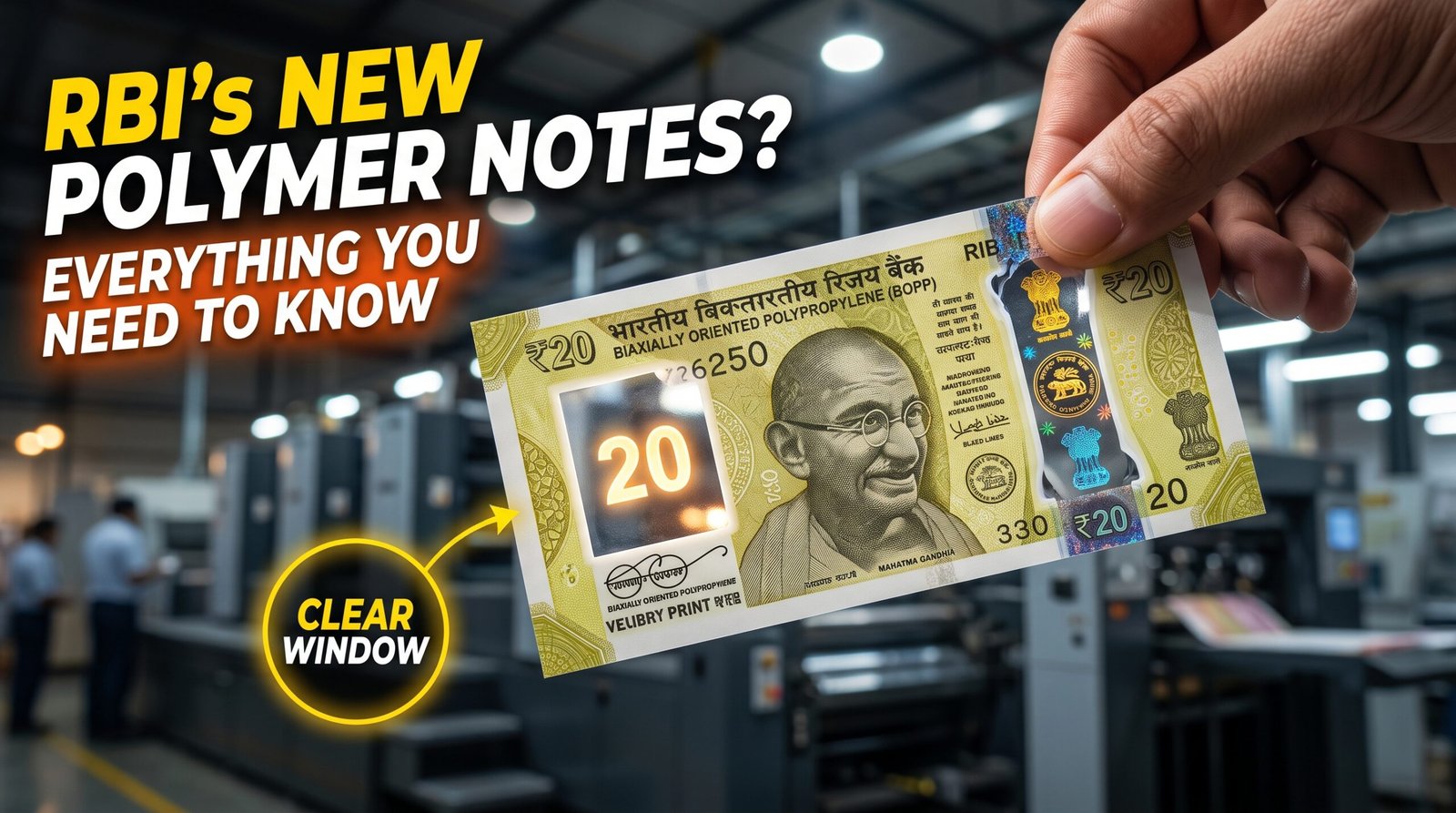
RBI Polymer Plastic Notes: Everything You Need to Know Updated: Aug 2026 | 🎯 15 MCQs

⚠️ Content Protected

Join our Telegram for PDF: t.me/BankPromotionExamGuide

RBI Polymer Plastic Notes: Everything You Need to Know Updated: Aug 2026 | 🎯 15 MCQs

Q 1 / 15
Which two denominations have been approved by the government in August 2026 for the introduction of polymer banknotes for field trials?
A. ₹10 and ₹50
B. ₹10 and ₹20
C. ₹20 and ₹100
D. ₹50 and ₹100
Under which section of the Reserve Bank of India Act, 1934, did the RBI send the proposal to the government for the introduction of polymer banknotes?
A. Section 22
B. Section 24
C. Section 25
D. Section 26
What quantity of polymer banknotes for each of the approved denominations has the government cleared for the initial field trials?
A. 500 million pieces each
B. 1 billion pieces each
C. 2 billion pieces each
D. 5 billion pieces each
How will the newly approved polymer banknotes be issued in relation to the existing currency during the trial?
A. They will immediately replace all existing paper banknotes.
B. They will be issued exclusively in specific metropolitan cities.
C. They will be issued along with the existing paper substrate-based banknotes.
D. They will only be issued digitally as a Central Bank Digital Currency.
While traditional Indian banknotes are primarily composed of 100% cotton comber and linter fibers,

what is the primary base material for the newly approved polymer banknotes?
A. Non-porous plastic film
B. Biodegradable hemp paper
C. Recycled synthetic cotton
D. Metallic-infused linen
The field trials for the newly approved polymer banknotes are strategically planned across specific cities in India.

What is the primary scientific rationale for selecting these diverse locations?
A. To test the notes' compatibility with different local languages printed on the currency
B. To evaluate the substrate's resilience across drastically different climatic and geographic zones
C. To determine if metropolitan areas have a higher counterfeit rate than rural areas
D. To restrict the monetary supply temporarily in specific high-inflation cities
Which of the following is a distinct Level-1 (publicly recognizable) security feature inherently enabled by the use of a polymer substrate, which cannot be organically integrated into traditional cotton-paper banknotes?
A. Optically Variable Ink (OVI)
B. Magnetic security threads
C. A completely clear, transparent window
D. Intaglio (raised) printing
Based on global central banking data and the rationale for the Indian field trials, polymer banknotes are estimated to have a lifespan that is approximately how many times longer than traditional cotton-paper notes?
A. 1.2 to 1.5 times longer
B. 2.5 to 4 times longer
C. 7 to 9 times longer
D. 15 to 20 times longer
How does the end-of-life disposal process for polymer banknotes fundamentally differ from that of traditional cotton-based Indian banknotes?
A. Polymer notes are buried in specialized landfills, whereas cotton notes are incinerated for energy.
B. Polymer notes are melted and recycled into plastic products, whereas cotton notes are shredded and compressed into briquettes.
C. Polymer notes are chemically dissolved into liquid waste, whereas cotton notes are composted into agricultural fertilizer.
D. Polymer notes are permanently stored in central bank vaults, whereas cotton notes are sold as scrap paper.
While India is currently initiating field trials for polymer banknotes in 2026, which central banking authority was the first in the world to introduce a complete series of polymer banknotes starting in the late 1980s?
A. Bank of England (United Kingdom)
B. Reserve Bank of Australia (Australia)
C. Bank of Canada (Canada)
D. Swiss National Bank (Switzerland)
The Reserve Bank of India has selected five specific cities to conduct the field trials of the new polymer banknotes to test their endurance in diverse climatic conditions.

Which of the following is the correct list of these five cities?
A. Mumbai, Delhi, Kolkata, Chennai, and Bengaluru
B. Kochi, Mysuru, Jaipur, Shimla, and Bhubaneswar
C. Ahmedabad, Surat, Pune, Nagpur, and Indore
D. Guwahati, Shillong, Imphal, Aizawl, and Gangtok
Because the base substrate of a polymer banknote is a completely transparent plastic film, which crucial manufacturing step must be executed before standard offset and intaglio inks can be printed onto the note?
A. Application of a magnetic metallic foil
B. Application of a white opacifying layer
C. Immersion in liquid nitrogen for hardening
D. Lamination with a secondary cotton mesh
When analyzing the economic viability of replacing traditional currency with polymer banknotes, how does the cost of polymer notes compare to cotton-paper notes?
A. Polymer notes have a lower initial printing cost and a lower lifecycle cost.
B. Polymer notes have a higher initial printing cost but a lower overall lifecycle cost.
C. Polymer notes have a lower initial printing cost but a higher overall lifecycle cost.
D. Polymer notes have a higher initial printing cost and a higher overall lifecycle cost.
How does the shift from cotton-paper to a polymer substrate specifically benefit visually impaired citizens who rely on tactile features to identify currency denominations?
A. Polymer allows the notes to audibly click when folded, indicating the denomination.
B. Polymer's rigid, non-porous structure prevents raised intaglio prints and Braille marks from flattening out over time.
C. Polymer notes are cut into different distinct geometric shapes (triangles, squares) based on their value.
D. Polymer naturally generates a slight electrostatic charge that can be felt by the fingertips.
According to lifecycle assessments driving the global shift toward plastic currency,

what is the net environmental impact of polymer banknotes compared to traditional cotton banknotes regarding Global Warming Potential (GWP)?
A. Polymer notes generate roughly 32% less GWP than cotton notes over their entire lifecycle.
B. Polymer notes generate 50% more GWP due to the extraction of petroleum for plastics.
C. Polymer notes and cotton notes have an identical GWP footprint.
D. Polymer notes generate 90% less GWP because they do not require any electricity to print.
Rate this: Avg 0.0 (0 votes)

Polymer Plastic Notes

The shift toward Polymer Plastic Notes is one of the most monumental updates to India’s currency system in decades, and it is actively being tested right now. If you are preparing for RBI Grade B, RBI Assistant, SBI PO, SBI Clerk, IBPS PO, IBPS Clerk, RRB PO and Clerk, Bank Promotion, or other banking exams, you absolutely must master the technical and economic mechanics behind this massive project. For years, our central bank has relied on traditional cotton-paper currency. However, low-denomination notes wear out rapidly, forcing the printing presses into an endless, expensive cycle of destruction and replacement. To fix this, a highly calculated scientific field trial is rolling out across specific Indian cities to test a durable, high-tech plastic film alternative. In this comprehensive guide, we are going to break down the exact legal sections of the RBI Act that make this possible. We will explore the fascinating material science behind biaxially oriented polypropylene, dig into the core economics of currency lifespan, and reveal how this new substrate fights counterfeiting with transparent windows. Grab your notebook, and let us dive into the mechanics of India’s currency evolution.
The legal authority to change the material of Indian currency from traditional cotton-paper to a polymer substrate is strictly governed by Section 25 of the Reserve Bank of India Act, 1934.

Integrating Polymer Plastic Notes into the Indian economy is not merely a scientific experiment; it is a profound legal and monetary operation. Before a single piece of plastic currency can be printed at the presses in Salboni or Mysuru, the Reserve Bank of India (RBI) must navigate a highly specific legal framework. For banking exams, understanding this statutory backing is non-negotiable. You must know exactly which sections empower the RBI to issue currency, determine its design, and guarantee its legal tender status.

The discourse surrounding Polymer Plastic Notes in India has been ongoing for over a decade. Earlier initiatives aimed at increasing the lifespan of low-denomination currency were frequently delayed due to logistical hurdles. However, the August 2026 approval formally invoked the necessary legal provisions to transition from theory to a massive, real-world field trial.

To fully grasp how the RBI operates in this domain, we need to look at the foundational legislation. Here is a breakdown of the critical legal sections you will encounter in your exams.

RBI Act, 1934 SectionPrimary Function Regarding CurrencyRelevance to the 2026 Trial
:—:—:—
Section 22Grants the RBI the sole right to issue banknotes in India.Establishes the RBI as the exclusive authority managing the trial.
Section 24Specifies the denominations of notes that can be issued (up to ₹10,000).Validates the selection of ₹10 and ₹20 denominations.
Section 25Dictates the design, form, and material of bank notes.The exact legal trigger used to approve the polymer substrate.
Section 26Guarantees the legal tender character of notes issued by the RBI.Ensures the new trial notes hold undisputed monetary value.

A very common mistake candidates make during banking interviews or objective exams is confusing Section 22 with Section 25. Remember this rule: Section 22 gives the RBI the power to issue the money, but Section 25 dictates what the money looks like and what it is made of. If a question asks about changing the substrate from cotton to plastic, the answer is always Section 25.

Section 25 Explained: Statutory Backing for Substrate Upgrades

Section 25 mandates that the design, form, and material of bank notes shall be such as may be approved by the Central Government after considering the recommendations made by the Central Board of the RBI.

This means the RBI cannot simply decide to print Polymer Plastic Notes on a whim. It requires a formal proposal from the RBI Central Board, followed by explicit clearance from the Ministry of Finance and the Reserve Bank of India Act, 1934 framework. Altering the physical substrate of sovereign currency requires ironclad statutory backing so the new notes hold unambiguous legal tender status.

Here is a visual representation of how the legal approval pipeline functions:

Currency Substrate Upgrade Protocol (Sec 25)
 ├── Step 1: RBI Central Board
 │  └── Drafts proposal highlighting cotton-paper lifespan inefficiencies.
 ├── Step 2: Department of Currency Management (DCM)
 │  └── Formulates technical specs for the polymer substrate.
 └── Step 3: Central Government (Ministry of Finance)
    └── Grants final statutory approval for field trials.
Substrate
Legal Tender
Central Board Recommendation

Analyzing the One Billion Field Trial Scale and Co-Circulation Policy

Once the legal hurdles were cleared, the government had to define the parameters of the field trial. They approved exactly one billion pieces each for the ₹10 and ₹20 denominations. Why such a massive number? India’s economy is vast, and a small sample size would yield statistically insignificant data regarding wear-and-tear.

To understand the sheer scale of this monetary injection, let us look at the mathematical volume of the trial:
Let $N_{10}$ represent the ₹10 notes and $N_{20}$ represent the ₹20 notes.
$N_{10} = 1 \times 10^9$ pieces
$N_{20} = 1 \times 10^9$ pieces
Total Trial Volume = $N_{10} + N_{20} = 2,000,000,000$ (Two Billion Notes)
Denomination Substrate Type Approved Quantity Primary Target User Base
₹10 Note BOPP Polymer 1 Billion Pieces Daily wage earners, street vendors, public transit
₹20 Note BOPP Polymer 1 Billion Pieces Retail grocers, rural markets, high-velocity cash users

Crucially, the RBI is implementing a Co-circulation Policy for these newly approved Polymer Plastic Notes.

Why is co-circulation necessary? If the RBI were to withdraw all existing paper ₹10 and ₹20 notes during the field trial, it would trigger a massive liquidity crunch and unnecessary public panic—similar to the psychological shocks experienced during demonetization. Co-circulation ensures a frictionless transition. It allows the existing cotton-substrate notes to remain fully active as legal tender alongside the new plastic variants. This dual-circulation environment provides the RBI with the perfect real-world laboratory to directly compare the degradation rates of both materials simultaneously.
New Polymer Notes Issued
+
Existing Paper Notes Remain Active
=
Smooth Co-Circulation Environment

By adhering strictly to Section 25 and rolling out exactly two billion pieces under a safe co-circulation strategy, the RBI is ensuring that this monumental shift in monetary policy is legally sound, economically stable, and scientifically measurable.


The Material Science Behind Polymer Plastic Notes

The primary base material for the newly approved banknotes is a clear, non-porous plastic film, specifically a material known scientifically as Biaxially Oriented Polypropylene (BOPP).

To truly master the mechanics of India’s currency evolution for your banking exams, we must move past economics and step into material science. For decades, the Reserve Bank of India has printed its cash on a substrate made of $100\%$ cotton comber and linter fibers. Cotton is excellent for printing crisp designs, but it has a fatal flaw: it is highly porous. As we discussed in the legal sections, transitioning the physical substrate of Indian currency management requires precise technical execution to solve this exact porosity problem.

Biaxially Oriented Polypropylene (BOPP) is a specialized thermoplastic film stretched in two distinct directions—both lengthwise and widthwise—during manufacturing. This dual-stretching process creates a substrate that is exceptionally strong, totally transparent, and entirely waterproof.

    Why BOPP Outperforms Cotton Comber: Zero Porosity: It completely repels human sweat, street dirt, and atmospheric moisture. High Tensile Strength: It strongly resists tearing, crinkling, and folding fatigue. Chemical Resistance: It does not break down when exposed to common household oils or mild solvents. Thermal Stability: Designed to maintain structural integrity even in intense summer heat without melting.

Think of a traditional banknote like a thick, high-quality cotton t-shirt. When you touch it with sweaty hands, the cotton physically absorbs the moisture. Over just a few months, this constant absorption softens the fibers, making the note limp, dirty, and unusable. When analyzing Polymer Plastic Notes, it is crucial to understand that they act more like a durable rain jacket. Moisture and dirt simply sit on the surface and can easily be wiped away.

Substrate MetricTraditional Cotton-PaperBOPP Polymer
:—:—:—
Base Material$100\%$ Cotton ComberNon-porous plastic film
PorosityHigh (absorbs moisture/dirt)Zero (repels liquids/oils)
Tactile FeelSoft, textured paperSmooth, rigid plastic
VulnerabilityEasily tears when dampHighly resistant to tearing

The Crucial Opacifying Layer in Banknote Manufacturing

Because the base substrate of BOPP is a completely transparent plastic film (much like a piece of clear glass), standard currency printing techniques cannot be used immediately. Printers cannot simply apply standard inks directly to clear plastic.

Before any colorful designs, Gandhi portraits, or denomination numbers can be printed, the substrate must undergo a mandatory preparatory phase called opacification.

Polymer Manufacturing Sequence
 ├── Step 1: Substrate Creation
 │  └── Clear BOPP plastic film is extruded and stretched.
 ├── Step 2: Opacification Phase
 │  └── White opacifying ink is applied on both sides, creating a solid canvas.
 ├── Step 3: Security Window Masking
 │  └── Specific areas are intentionally left clear (unpainted) for security.
 └── Step 4: Traditional Printing
    └── Offset and raised intaglio inks are applied to the opaque areas.
Why is this white opacifying layer absolutely necessary? If standard offset inks were printed directly onto clear plastic without an opacifying layer, the note would be entirely see-through. The front and back designs would visually clash into a messy, unreadable blur. The white layer acts as the solid background canvas that allows the final artwork to pop.

A very common mistake students make is assuming the plastic itself is manufactured to be white. It is not! The raw BOPP film is completely transparent. The “white” background you see on the final currency is actually two thick layers of specialized opacifying ink.

Application of Standard Offset and Intaglio Inks

Once the white canvas is applied, the manufacturing process begins to resemble traditional currency printing. However, making authentic Polymer Plastic Notes requires highly calibrated presses to ensure the ink binds permanently to the plastic surface.

To visualize how these layers stack up, examine this cross-sectional breakdown:

4. Clear Protective Varnish 3. Offset & Intaglio Design Inks 2. White Opacifying Ink Layer 1. Clear BOPP Base Substrate

In traditional cotton-paper notes, the paper itself naturally provides the opaque white canvas and absorbs the ink deep into its fibers. Shifting to plastic requires this entirely new layered printing phase. Once the final colors and raised textures are applied, the entire note is coated in a thin, clear varnish to seal everything tightly.
BOPP Film
Opacifying Layer
Intaglio Printing
Tensile Strength

This rigorous, multi-layered process ensures Polymer Plastic Notes retain their vivid designs, structural rigidity, and anti-counterfeiting properties even after years of rough, real-world circulation.


Advanced Security and Accessibility of Polymer Plastic Notes

The introduction of Polymer Plastic Notes revolutionizes currency security by enabling fully transparent anti-counterfeiting windows, while their rigid, non-porous structure ensures tactile features for the visually impaired remain intact for years.

When evaluating the shift to new currency substrates for banking exams, you must look beyond basic durability. The Reserve Bank of India (RBI) is locked in a constant arms race against highly sophisticated counterfeiters. Simultaneously, the RBI has a strict mandate to ensure financial inclusion for all citizens, including the visually impaired. Traditional cotton-paper fails on both fronts. Modern commercial scanners can easily replicate paper watermarks, and human sweat rapidly destroys the raised ink meant for touch-based identification.

This phase will explore exactly how the structural mechanics of Polymer Plastic Notes solve these two critical issues simultaneously.

Level-1 Security: The Transparent Window

A transparent window is a clear, see-through section of a banknote created by intentionally leaving a specific portion of the plastic substrate completely unprinted. This serves as a “Level-1” security feature—meaning the general public can instantly recognize and verify it without any special tools or UV lights.
In the past, counterfeiters relied on complex printing presses. Today, high-end commercial digital scanners and laser printers can achieve resolutions so sharp that they can easily forge the traditional Gandhi watermarks and magnetic security threads found on cotton-paper notes. However, standard scanners are fundamentally incapable of replicating a physical transparent hole in a continuous sheet of currency.
Security FeatureTraditional Cotton-PaperPolymer Substrate
:—:—:—
Window CreationRequires punching a physical hole and gluing a patchNaturally clear base material; just leave it unpainted
Structural IntegrityVery weak at the glued seams (prone to tearing)$100\%$ seamless and structurally uniform
Scanner VulnerabilityHigh (watermarks easily scanned and printed)Zero (scanners cannot print “transparency”)
Public VerificationRequires holding to light to see watermarkInstant visual verification of the clear window

Why Cotton Cannot Compete in Modern Security

If you want to put a clear window into a traditional cotton-paper note, you have to physically punch a hole through the paper and glue a piece of plastic tape over it. This creates a massive structural weakness. When a citizen folds the note repeatedly, the glued seams quickly crack, and the note falls apart. Because Polymer Plastic Notes are already made of a continuous sheet of clear Biaxially Oriented Polypropylene (BOPP), creating a window requires zero cutting. The printing machines simply skip applying the white opacifying layer over that specific geometric area.

To visualize how counterfeiters are blocked by this technology, look at this structural hierarchy of security layers:

Substrate Security Hierarchy
 ├── Level-1: Public Verification
 │  ├── Transparent BOPP Windows (Cannot be photocopied)
 │  └── Holographic foil stamped directly into the clear window
 ├── Level-2: Teller Verification
 │  └── Micro-printing visible only under standard bank magnifiers
 └── Level-3: Central Bank Verification
    └── Proprietary chemical markers embedded inside the plastic

A frequent trap in objective exams is asking how the transparent window is “cut out” of the plastic. Remember: nothing is cut! The window exists because the base material is inherently clear, and the manufacturer deliberately omits the opaque ink in that spot.

Tactile Features: Empowering the Visually Impaired

Tactile features refer to the deeply raised geometric patterns—such as small lines, circles, or dots—printed on the extreme edges of banknotes. These are printed using a technique called heavy intaglio printing, which applies massive pressure to force thick ink into raised structures, allowing visually impaired individuals to identify the denomination entirely by touch.

While the RBI currently prints these raised bleed lines on traditional cotton notes, advocacy groups have repeatedly pointed out a severe mechanical failure. Cotton is highly porous. It absorbs human sweat, atmospheric moisture, and natural skin oils.

Let us look at the physics of ink degradation. If we define the rate of ink flattening as $R_{flatten}$, it is directly proportional to moisture absorption:
$R_{flatten} \propto \text{Moisture Absorption}$

Because cotton absorbs moisture constantly, the strong raised ink softens rapidly. Within a few months of active circulation in a humid country like India, those crucial raised lines flatten completely, rendering the note unidentifiable to a blind citizen.

Cotton Note + Sweat
Fibers Soften & Expand
Raised Ink Flattens Out (Fails)

The Rigid Advantage of Plastic Film

Because Polymer Plastic Notes are made of non-porous BOPP film, their moisture absorption rate is practically zero. Water, sweat, and oils are actively repelled.


    Why Polymer Sustains Tactile Features: Absolute Rigidity: The plastic substrate does not expand or contract when handled with wet hands. Ink Adhesion: The heavy intaglio ink binds permanently to the opacifying layer, creating a hardened bump. Friction Resistance: The smooth surface of the plastic drastically reduces the friction of daily wallet storage. Lifelong Accessibility: The tactile dots remain sharp and easily readable by touch for the entire multi-year lifespan of the note.
Tactile Features
Intaglio Printing
Level-1 Security
Non-porous Structure

By bridging the gap between high-tech visual security and physical accessibility, the substrate upgrade proves its worth far beyond simple longevity. This dual-purpose utility is exactly why over 60 central banks globally have already made the transition.


Economic Viability and Lifecycle Economics of Polymer Plastic Notes

Although they are significantly more expensive to manufacture initially, Polymer Plastic Notes yield massive long-term financial savings because they stay in circulation up to four times longer than traditional cotton-paper currency.

If you want to score high in the general awareness and economic sections of banking exams, you must fundamentally understand how central banks calculate the cost of money. A central bank does not just print money once; it must constantly replace soiled, torn, and unfit notes. This continuous replacement cycle costs the Reserve Bank of India (RBI) thousands of crores annually. The economic model driving the adoption of Polymer Plastic Notes relies entirely on the distinction between initial printing costs and the total lifecycle cost.

Lifecycle Cost Analysis in currency management measures the total financial burden of a denomination from its initial printing, through its distribution, processing, and eventual destruction, spread across its operational lifespan.
Economic MetricTraditional Cotton-PaperPolymer Substrate
:—:—:—
Initial Unit CostLow (Cheaper base materials)High ($\sim 1.5\times$ to $2\times$ more expensive)
Replacement FrequencyHigh (Every $1$ to $1.2$ years)Low (Every $3$ to $4$ years)
Logistics BurdenHeavy (Constant transport of replacements)Light (Fewer replacement shipments needed)
Net Lifecycle CostHigh (Compounding recurring costs)Low (Massive long-term operational savings)

The Lifespan Multiplier Effect in Currency

To grasp the true savings, we must calculate the “Lifespan Multiplier.” Low-denomination cotton notes, like the ₹10 and ₹20, currently wear out extremely fast due to their high velocity of circulation. They change hands daily among street vendors, grocers, and commuters. Typically, a cotton ₹10 note becomes “unfit” and must be shredded by the RBI in roughly one year.

In stark contrast, global data shows that biaxially oriented polypropylene (BOPP) notes achieve a lifespan multiplier of roughly $2.5\times$ to $4\times$. This means a single plastic note will survive in the same harsh conditions for up to four years before it needs to be destroyed.

4 Years 3 Years 1 Year Cotton-Paper BOPP Polymer


A classic examiner trick is to claim that plastic currency is cheaper to manufacture than paper. This is factually incorrect. The upfront capital expenditure to print Polymer Plastic Notes is substantially higher due to the complex opacifying layers and specialized BOPP film. The economic benefit comes strictly from the reduced frequency of replacement, not a cheaper unit cost.

Why Central Banks Target Low Denominations First

Why is the RBI starting field trials with the ₹10 and ₹20 denominations instead of high-value notes like the ₹500? The answer lies in the velocity of money. High-value notes are often stored in bank vaults, ATMs, or digital lockers. They experience very little physical friction. Low-denomination notes, however, are constantly subjected to sweat, oil, folding, and rough environments. Therefore, the return on investment (ROI) for switching to a highly durable substrate is maximized precisely at these lower, high-velocity tiers.
Lifecycle Cost Savings Pipeline
 ├── Phase 1: Initial Printing
 │  └── Higher Upfront Capital Expense (Unit Cost increases)
 ├── Phase 2: Active Circulation
 │  └── Note survives 4x longer (Zero replacement printing needed)
 └── Phase 3: Logistics & Processing
    └── Massive reduction in transport, sorting, and shredding costs
Cost VariableImpact on Total Economic Burden
:—:—
Unit Manufacturing PriceIncreases initial cash outlay for the central bank.
Distribution LogisticsDrops significantly; fewer armored transport runs.
Sorting & ValidationDrops significantly; clean plastic is easier for ATM sensors to read.
Destruction LogisticsDrops significantly; fewer trips to the incinerator/shredder.
Velocity of Circulation
Lifecycle Cost
Lifespan Multiplier
Logistical Overhead

By fully embracing this modern lifecycle cost strategy, India joins an elite tier of global economies optimizing their sovereign currency management. In the next phase, we will look at how the RBI scientifically tests this economic theory across India’s harshest climatic zones.


Geographic Strategy: Testing Polymer Plastic Notes Across Climatic Zones

The Reserve Bank of India has strategically selected five distinct tier-2 and tier-3 cities—Kochi, Mysuru, Jaipur, Shimla, and Bhubaneswar—to scientifically evaluate how drastically different environmental stresses affect the new currency substrate before a nationwide rollout.

Before authorizing the printing presses to permanently replace cotton with Polymer Plastic Notes across the entire country, the central bank must guarantee that the plastic film will not melt, warp, or shatter under real-world conditions. India is geographically massive, functioning almost as a sub-continent with extreme meteorological variations. The physical behavior of a plastic substrate in the freezing, high-altitude air of the Himalayas is completely different from its behavior in the scorching, arid deserts of Rajasthan.

Climatic testing in currency management is the systematic exposure of trial banknotes to real-world meteorological extremes (such as heat, humidity, dust, and cold) to scientifically measure environmental degradation rates.

The Five Trial Cities Unpacked

To capture accurate data, the RBI intentionally avoided major metropolises like Delhi or Mumbai. Those cities have high rates of digital transactions and air-conditioned environments. Instead, they chose specific regional hubs that represent pure climatic extremes.
Climatic Trial Zones for Banknotes
 ├── Coastal & High Humidity
 │  ├── Kochi (Kerala) - Tests salt air and fungal growth resistance.
 │  └── Bhubaneswar (Odisha) - Tests monsoon moisture absorption.
 ├── Extreme Arid Heat
 │  └── Jaipur (Rajasthan) - Tests thermal stability and dust friction.
 ├── Cold & High Altitude
 │  └── Shimla (Himachal Pradesh) - Tests plastic brittleness in freezing temps.
 └── Moderate/Transitional
    └── Mysuru (Karnataka) - Serves as the moderate climate baseline control.
Why these exact cities? Because Biaxially Oriented Polypropylene (BOPP) is a thermoplastic, its absolute primary vulnerability is extreme heat and friction. Conversely, traditional cotton notes fail instantly due to high humidity. By forcing Polymer Plastic Notes into the hands of outdoor workers and coastal fishermen in these specific regions, the RBI ensures the currency undergoes the harshest physical stress tests possible.

A very common trick in banking exams is providing a multiple-choice option that lists India’s major metro cities (Mumbai, Delhi, Kolkata, Chennai) as the trial locations. Do not fall for this! The trial specifically targets diverse climatic zones, perfectly represented by Kochi, Mysuru, Jaipur, Shimla, and Bhubaneswar.

Understanding Vulnerabilities: Thermal and Moisture Stress

Previous RBI trial blueprints from the early 2010s also recommended these exact geographic profiles. While over 60 countries globally have successfully adopted plastic currency, few nations possess the drastic climatic swing that India does. A note printed in Salboni might end up in a snowy market in Shimla or a humid fish market in Kochi within the same month.

To quantify this, central banks often calculate a simplified Environmental Stress Index ($E_{si}$) during these trials. The equation tracks temperature, moisture, and friction:

$$E_{si} = \alpha(T_{max}) + \beta(H_{avg}) + \gamma(D_{particulate})$$

Where $T_{max}$ represents extreme high temperatures, $H_{avg}$ is the average ambient humidity, and $D_{particulate}$ is the abrasive dust friction. For the trial to be deemed a success, the new Polymer Plastic Notes must maintain an $E_{si}$ failure rate below $0.05\%$ across all five zones over the testing period.

Primary Substrate Threats by Region Jaipur Thermal Warping Kochi Fungal Growth Shimla Cold Brittleness

Climatic VariableTest Purpose on Polymer SubstrateAnticipated Outcome
:—:—:—
High HumidityTest resistance to moisture absorption.Zero liquid absorbed; ink remains intact.
Extreme HeatTest thermal stability.Plastic film does not warp or shrink.
Extreme ColdTest flexibility.Substrate does not become brittle or snap.
Dust / PollutionEvaluate ink adhesion.Varnish resists scratching and smudging.
Climatic Zones
Thermal Stability
Environmental Stress Index
Substrate Resilience

By decentralizing the field trials across these hyper-specific tier-2 and tier-3 cities, the RBI guarantees a scientifically sound dataset. If the notes survive here, they will easily survive anywhere else in the nation.


Global History and Environmental Impact of Polymer Plastic Notes

The global transition to Polymer Plastic Notes was pioneered by the Reserve Bank of Australia (RBA) in 1988, fundamentally driven by the need to outpace sophisticated counterfeiters while drastically lowering the overall Global Warming Potential (GWP) of sovereign currency.

To complete your preparation for banking exams, we must contextualize India’s upcoming field trials within the broader global framework. Understanding who invented this technology, why they invented it, and how it impacts the environment is a frequent topic in general awareness and economic paper sections. The shift away from traditional cotton-paper is not merely about making money last longer; it represents a fundamental move toward a sustainable, circular economy in central banking.

Life Cycle Assessment (LCA) is a highly specialized environmental accounting method used by central banks to calculate the exact carbon footprint—measured in Global Warming Potential (GWP)—of a banknote from its initial raw material extraction to its final destruction.

Australia: The Global Pioneer of Plastic Currency

While the Reserve Bank of India is launching large-scale trials for Polymer Plastic Notes in 2026, the technology itself is nearly four decades old. In the late 1960s, Australia faced a massive counterfeiting crisis when standard paper notes were heavily forged following the introduction of the new decimal currency system. To solve this, the Reserve Bank of Australia teamed up with the Commonwealth Scientific and Industrial Research Organisation (CSIRO) to invent an entirely new substrate.

They realized that the only way to beat advanced printers was to create a material that inherently featured a transparent, see-through window.

Global Adoption Timeline
 ├── 1988 - The Invention
 │  └── Australia issues the world's first $10 commemorative polymer note.
 ├── 1996 - Full Transition
 │  └── Australia becomes the first nation to transition all denominations to plastic.
 ├── 2010s - Global Expansion
 │  └── Canada (2011) and the UK (2016) fully adopt BOPP substrates.
 └── 2026 - Indian Trials
    └── India initiates two-billion-piece field trial for ₹10 and ₹20 denominations.
Why did it take India so long to adopt this technology? India’s economy requires a massive volume of physical cash circulating in wildly diverse climatic conditions. The logistics of overhauling the printing infrastructure in Salboni and Mysuru, combined with the sheer scale of India’s population, required decades of planning and observation of other nations’ successes before executing a domestic trial.

Many students incorrectly guess that the Bank of England or the United States Federal Reserve invented plastic money. This is a classic exam trap! The United States still uses a cotton-linen blend for all its currency. The correct answer for the pioneer of plastic currency is always the Reserve Bank of Australia (RBA).

End-of-Life Disposal: The Circular Economy

End-of-life processing refers to the exact mechanical protocol a central bank uses when a banknote becomes too damaged to remain in circulation. This is where Polymer Plastic Notes present a massive environmental advantage.

Currently, when traditional Indian cotton-paper notes become soiled, the RBI uses massive industrial shredders to destroy them. The shredded cotton dust is then highly compressed into solid blocks called briquettes. These briquettes are typically sent to landfills or incinerated for industrial heating, which releases trapped carbon back into the atmosphere.

Because the new trial currency is made from Biaxially Oriented Polypropylene (BOPP)—a fully recyclable thermoplastic—the end-of-life process completely changes.

Unfit Polymer Note
Granulation (Chopped into bits)
Melted into Plastic Pellets
Recycled Secondary Goods

Comparing Global Warming Potential (GWP)

It might seem counterintuitive that a petroleum-based plastic product is better for the environment than natural cotton. However, environmental science relies on mathematics, not intuition.

According to comprehensive global studies, transitioning to Polymer Plastic Notes results in an approximate $32\%$ reduction in Global Warming Potential over the currency’s entire lifecycle.

Global Warming Potential (GWP) Lifecycle Comparison Cotton-Paper (100%) Polymer (68%) 32% Net Reduction Total Greenhouse Gas Emissions (From Extraction to Disposal)


    Why Plastic Wins the Environmental Test: Agricultural Overhead: Growing cotton requires massive amounts of fresh water, pesticides, and land clearing. BOPP is a highly lightweight petrochemical derivative that requires zero agricultural land. Transportation Weight: Polymer notes are thinner and lighter. Armored trucks burn less diesel fuel transporting billions of pieces across India. Replacement Frequency: Because plastic lasts up to four times longer, you only have to manufacture, transport, and destroy one plastic note for every four cotton notes. Methane Avoidance: Rotting cotton in a landfill produces methane (a highly potent greenhouse gas). Recycled plastic pellets produce zero methane.
Environmental PhaseTraditional Cotton-Paper ImpactBOPP Polymer Impact
:—:—:—
Sourcing MaterialsHigh (Water-intensive cotton farming)Moderate (Petroleum extraction)
ManufacturingModerate (Standard milling)High (Complex opacification and coating)
Active CirculationExtremely High (Constant re-printing required)Extremely Low (Survives for $4$ years)
End of LifeHigh (Incineration or Methane from landfill)Negative/Beneficial (Repurposed as plastic goods)
Global Warming Potential
Circular Economy
Granulation
Life Cycle Assessment

By fully understanding the historical origins in Australia and the precise environmental physics of the circular economy, you can confidently tackle the most advanced general awareness questions regarding India’s currency evolution.


Quick Revision

Section 25 of RBI Act, 1934 The specific statutory provision that grants the Reserve Bank of India the legal authority to change the material (substrate) of sovereign currency.
Biaxially Oriented Polypropylene (BOPP) The non-porous, waterproof, and highly durable clear plastic film used as the base substrate for the new notes.
Opacifying Layer Specialized white ink applied to the clear BOPP film to create a solid canvas, allowing standard designs and colors to be printed.
Transparent Window A Level-1 security feature created by intentionally leaving a section of the plastic unpainted, making it impossible for standard scanners to forge.
Co-circulation Policy The monetary strategy where new trial notes and existing cotton-paper notes are simultaneously used as active legal tender in the economy.
Lifespan Multiplier The economic metric proving plastic notes survive 2.5 to 4 times longer than paper notes, massively reducing lifecycle costs.
Tactile Features Retention The rigid plastic prevents raised intaglio ink from flattening out, ensuring the currency remains permanently identifiable to the visually impaired.
Reserve Bank of Australia (RBA) The first central banking authority in the world to invent and successfully issue a complete series of plastic currency in the late 1980s.

Frequently Asked Questions

Why is the RBI introducing Polymer Plastic Notes specifically in the ₹10 and ₹20 denominations first?
These lower denominations experience the highest velocity of circulation. They change hands constantly in daily street commerce, causing traditional cotton notes to wear out and tear within just one year. Upgrading these specific notes maximizes the central bank’s return on investment by drastically reducing frequent printing costs.
Will traditional cotton-paper notes lose their legal tender status during the 2026 field trials?
Absolutely not. The RBI is strictly utilizing a co-circulation policy. Both the existing paper notes and the newly introduced two billion plastic trial notes will function simultaneously as valid legal tender. This prevents public panic and ensures a smooth liquidity transition.
Are Polymer Plastic Notes cheaper to manufacture than traditional cotton currency?
Initially, no. The unit cost to manufacture a plastic note is significantly higher due to the expensive BOPP film and complex opacifying layers. However, because they last up to four times longer in circulation, their overall net lifecycle cost is drastically lower, saving the RBI massive amounts of money in the long term.
How do the new banknotes improve accessibility for visually impaired citizens?
Traditional cotton notes easily absorb human sweat and ambient moisture, which quickly softens and flattens the raised ink (tactile lines) meant for touch reading. The new non-porous plastic structure actively repels moisture, ensuring those heavily raised intaglio dots remain sharp, rigid, and readable for the note’s entire lifespan.
Why did the RBI choose cities like Jaipur and Kochi for the field trials instead of Mumbai or Delhi?
The trial is a rigorous scientific experiment designed to test the substrate’s limits. Jaipur exposes the currency to extreme arid heat and dust friction, while Kochi tests its resilience against coastal humidity and potential fungal growth. Major metro cities simply do not offer these isolated meteorological extremes.